Key Takeaways
- A useful checklist names the task, owner, evidence, due date, and unresolved item.
- Reconcile bank, card, gateway, customer, and supplier balances before relying on reports.
- Do not hide missing documents or force balances to agree.
- Add quarterly and year-end reviews without treating one timetable as universal.
A monthly bookkeeping checklist gives your SME a repeatable way to collect records, update the books, resolve differences, and prepare useful reports. The list should fit your accounts, systems, transaction volume, payment channels, and reporting needs.
What Belongs on a Monthly Bookkeeping Checklist?
A monthly bookkeeping checklist should cover source documents, transaction recording, coding, reconciliations, customer and supplier balances, payroll inputs, missing information, review notes, and secure filing. Assign an owner and evidence to every task. A tick alone is not enough if the supporting document or unresolved-item list cannot be found later.
Collect and Organise the Source Records
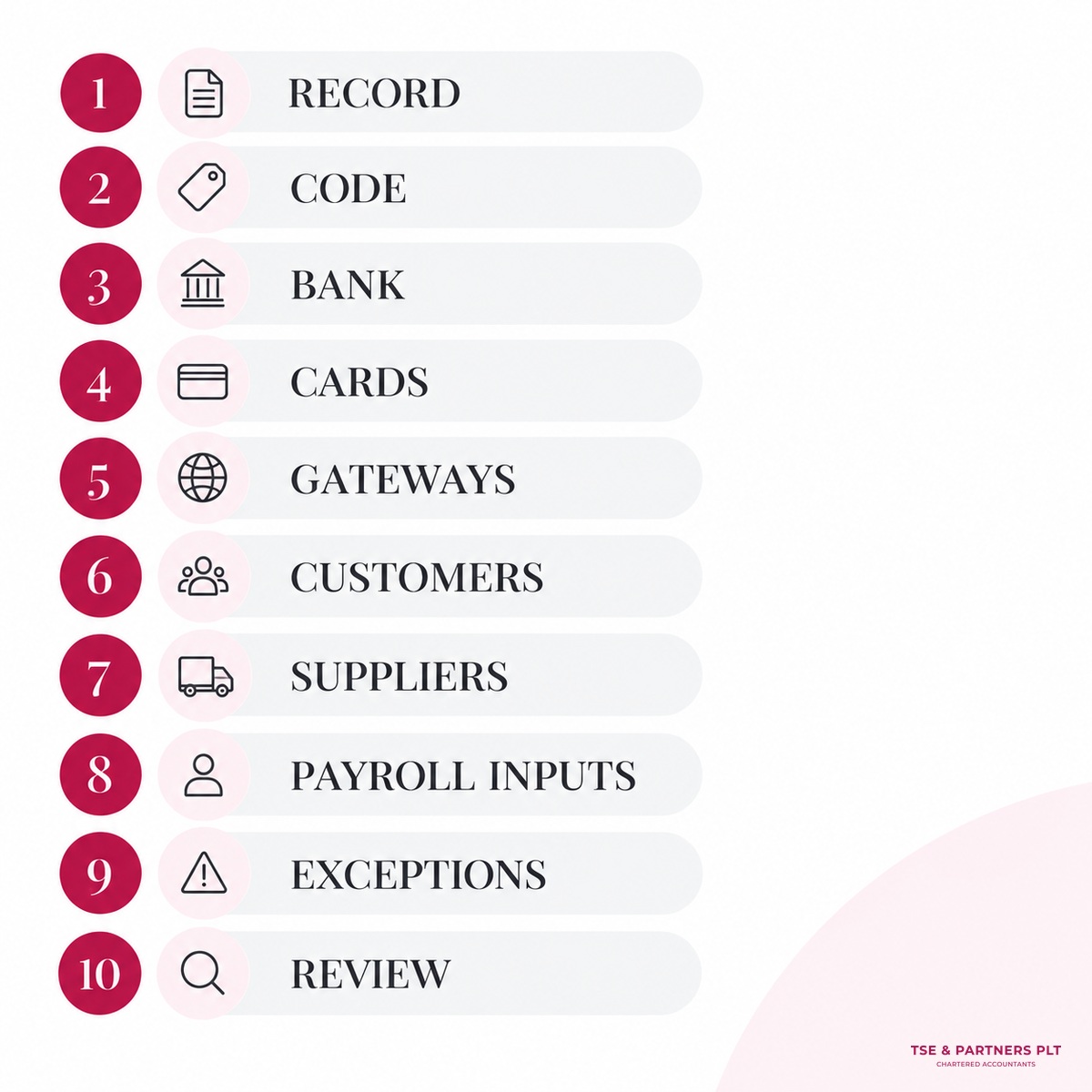
Gather the records for the exact period:
Sales invoices, credit notes, and customer receipts.
Supplier bills, debit notes, and payment records.
Expense receipts and approved claims.
Bank and card statements.
E-wallet, marketplace, and payment-gateway reports.
Payroll summaries and approved payroll inputs.
Transfers between business accounts.
Loan, hire-purchase, and financing records where relevant.
Prior-month reconciliation and unresolved-item lists.
Use one agreed submission place. Name files consistently and mark missing items before work starts. Do not post a guessed transaction simply to close the month.
Set a cut-off date and tell every document owner what must be submitted. A useful naming format includes the date, supplier or customer, document type, and amount. Keep the original file when possible. If a receipt is supplied through a chat message, save it in the agreed folder rather than relying on the chat history.
Check that the record is readable and complete. A payment screenshot may show that money moved, but it may not explain the business purpose, supplier, tax treatment, or period. Link the payment to the invoice, receipt, approval, or other support needed for the bookkeeping entry.
Use a missing-record log from the start of the close. Record the document requested, transaction date, amount, owner, request date, follow-up date, and current status. This prevents the same question from being sent several times and shows which gaps may affect the reports.
Complete These 10 Monthly Bookkeeping Checks
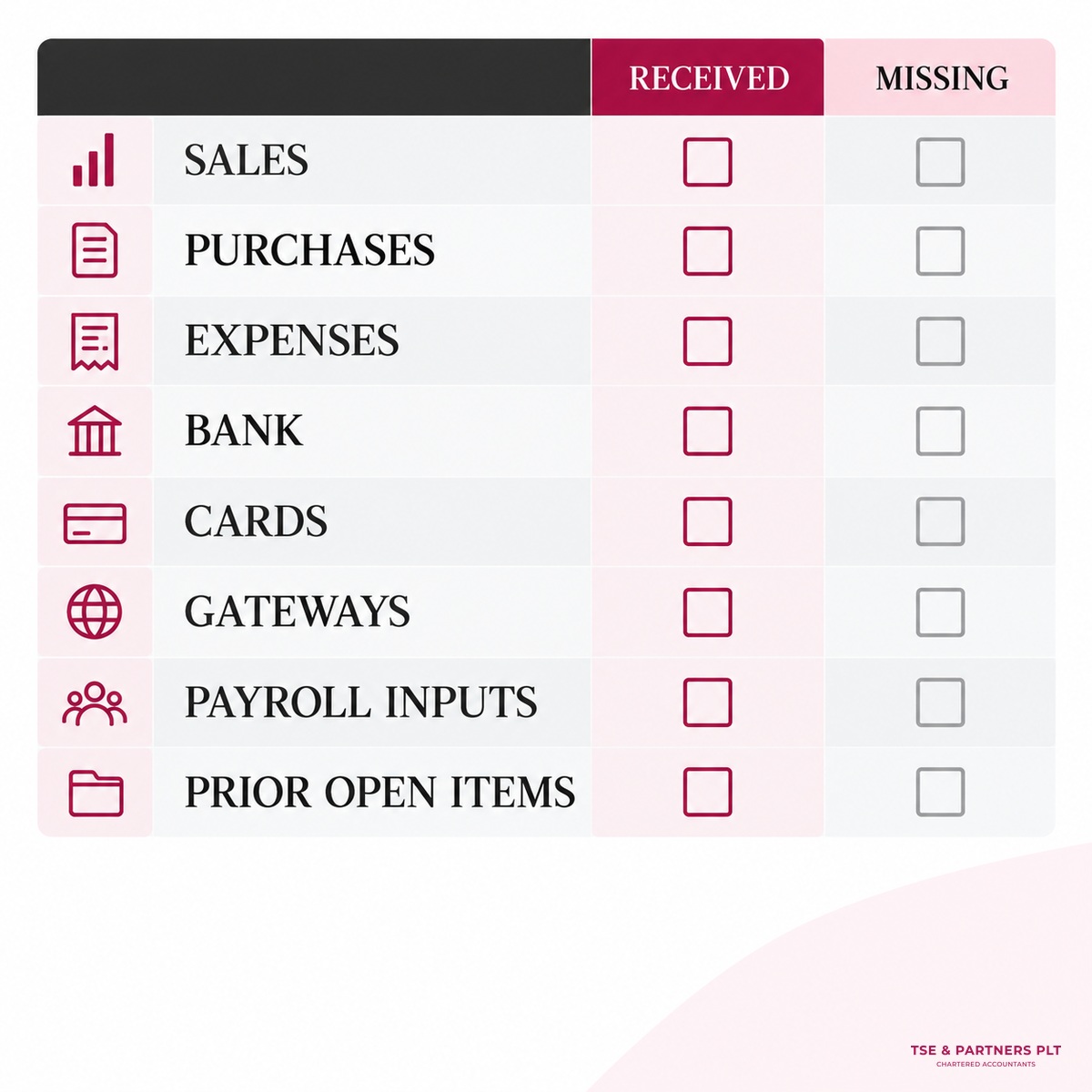
Record sales, purchases, receipts, payments, and supported journals.
Check dates, descriptions, account codes, and tax treatment where applicable.
Reconcile each bank account for the same period.
Reconcile business cards, e-wallets, marketplaces, and payment gateways used by the business.
Review customer balances and record collection follow-ups.
Review supplier balances and amounts due soon.
Check transfers between accounts and entities so both sides are recorded.
Review payroll entries against approved payroll information.
List missing documents, duplicates, unusual entries, and old open items.
Prepare the agreed reports and obtain the required review or approval.
A bank reconciliation statement helps separate timing items from entries that need correction. If the books and bank do not agree, keep the difference open with an owner and next action.
Define what each completion status means. For example:
| Status | Meaning | Required evidence |
|---|---|---|
| Not started | Work has not begun | None yet |
| In progress | Records are being prepared | Working file or document list |
| Waiting | Another person must provide information | Missing-item log and owner |
| Ready for review | Preparation is complete | Reconciliation or supporting schedule |
| Completed | Review is finished | Reviewer name, date, and resolved notes |
Do not mark a task complete when a material difference is hidden in a suspense or miscellaneous account. Keep the exception visible, state what is known, and record the next action. If management accepts a temporary limitation, document who accepted it and when the matter will be revisited.
After the close, lock or clearly label the completed period where the system allows it. If a later correction is needed, keep a change record showing the date, reason, preparer, reviewer, and reports affected.
Review Quarterly and Year-End Readiness
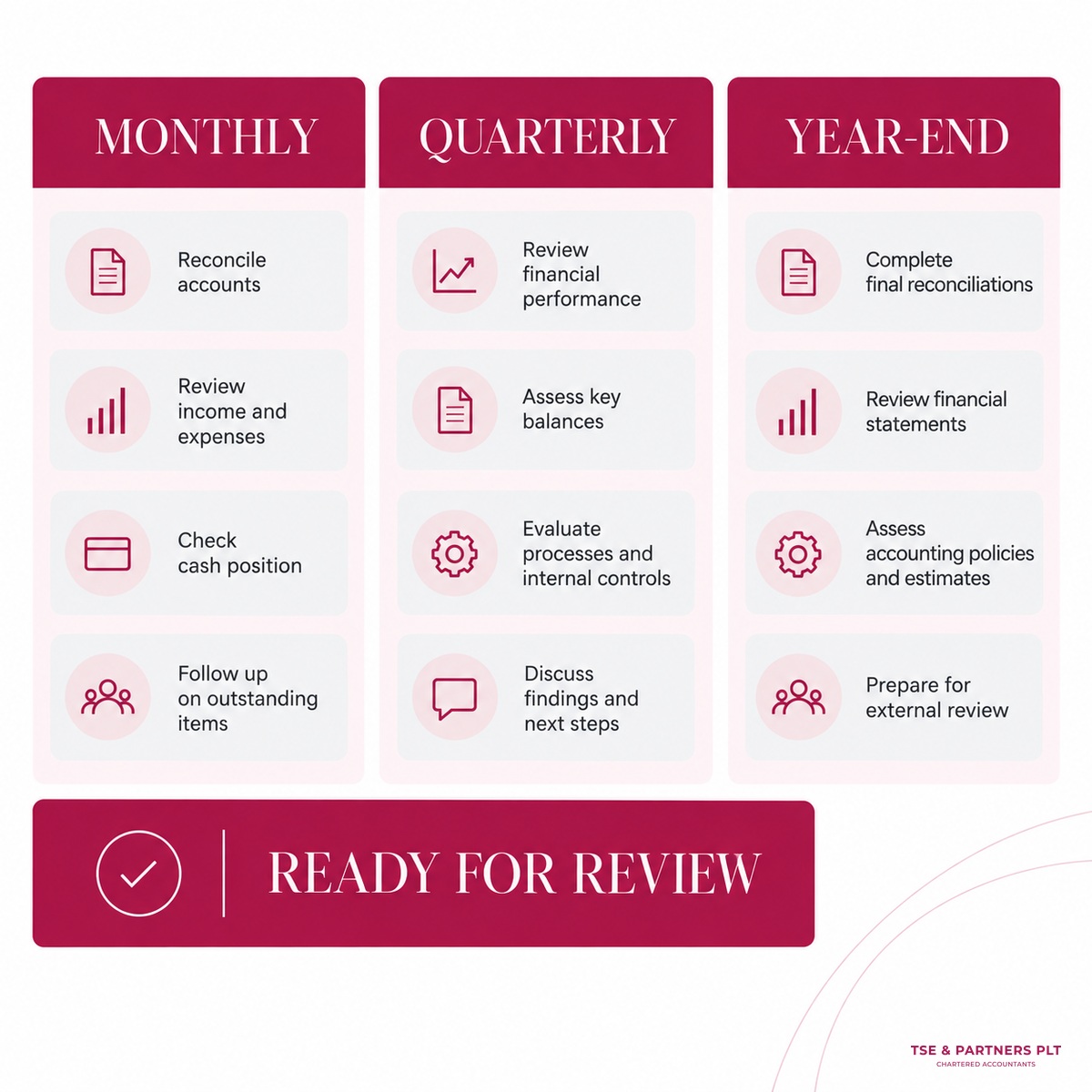
Every quarter, look beyond one month. Review old unresolved balances, repeated coding errors, customer ageing, supplier commitments, cash pressure, margin changes, and whether management needs different reports.
Before year-end, confirm that opening balances agree with prior closing records, reconciliations are complete, schedules support material balances, intercompany differences are listed, and unanswered questions have owners. Organise the hand-off rather than waiting for the adviser to rediscover missing items.
Use the wider review cycle to check items that a monthly close may not resolve:
| Review cycle | Checks to perform | Evidence to retain |
|---|---|---|
| Monthly | Transactions, bank and payment channels, customers, suppliers, payroll inputs, exceptions | Ledgers, reconciliations, aged lists, missing-item log |
| Quarterly | Old balances, repeated errors, cash pressure, margin movement, access rights, reporting needs | Review notes, trend reports, updated action list |
| Year-end | Opening balances, key schedules, financing, fixed assets, intercompany balances, director information | Year-end file, schedules, confirmations, unresolved-item summary |
The quarterly review should look for patterns. Repeated missing receipts may point to a weak collection process. Repeated late reconciliations may mean the cut-off is unrealistic or nobody owns a payment channel. Fix the process rather than adding the same warning every quarter.
At year-end, agree what the external adviser or associate needs, who will answer questions, and how corrections will be approved. Keep the final reports and supporting schedules together so the next period starts from a clear closing position.
A management account sample shows how completed records can support variance review and actions. The guide to unaudited financial statements in Malaysia explains why preparation remains important even when no audit opinion is provided.
Assign Every Task an Owner and Evidence
Use a control table for your own process:
| Task | Owner | Evidence | Due date | Open issue |
|---|---|---|---|---|
| Collect bank statements | Statement saved | |||
| Reconcile bank account | Signed reconciliation | |||
| Review receivables | Aged list and notes | |||
| Review supplier balances | Supplier list | |||
| Approve period reports | Review record |
Separate preparation from review. The person recording an item should not be the only person deciding whether an unusual balance is acceptable when another review is practical.
Handle Missing Records and Outside Support
For each gap, record the amount, date, account, evidence requested, owner, and next follow-up. Do not plug an unexplained difference into a convenient account. If records regularly arrive late, change the collection process instead of repeating the same month-end problem.
Use a simple escalation path. Send the first request to the document owner, then follow up on the agreed date. Escalate an overdue or material item to the person responsible for the close. State which balance or report may be incomplete. Do not describe a report as final when a known gap could change it.
When work is shared with an outside provider, agree the hand-off in writing. The business may collect and approve documents, while the provider records, reconciles, and reports. Name who reviews each output and who can authorise a correction. This avoids the common gap where both sides assume the other person is responsible.
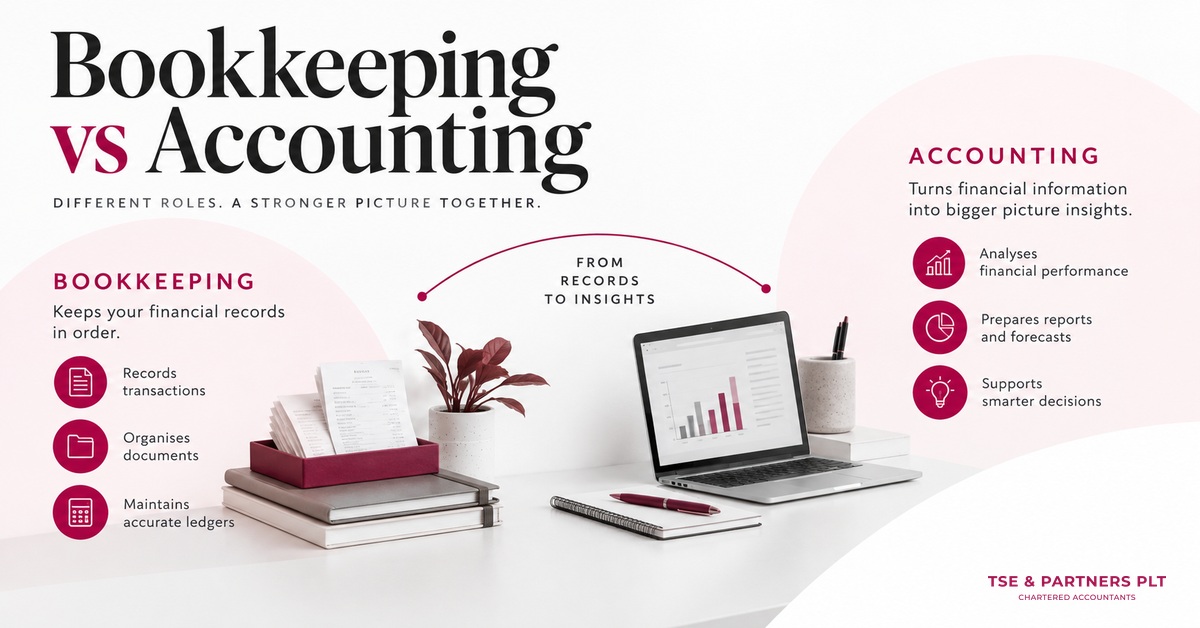
Understanding bookkeeping versus accounting helps assign preparation and review work. When comparing support, use accounting service fees in Malaysia to compare the same volume, cadence, outputs, and exclusions.
TSE & Partners supports accounting and bookkeeping services in Kuala Lumpur through associates. The scope can be set around recurring bookkeeping, record setup, reporting, compilation, consolidation, or agreed catch-up work. Audit and assurance are outside this scope.
Monthly Bookkeeping Questions SMEs Ask
Must every SME use the same checklist?
No. Adapt it to your accounts, systems, payment channels, volume, people, and reporting needs.
Is monthly reconciliation always enough?
Not always. A higher-volume business or one with several payment channels may need more frequent checks.
Can software complete every task?
Software can import data and suggest matches. People still need to check evidence, resolve exceptions, approve changes, and review reports.
What should happen to missing receipts?
Record the gap, request the document, name an owner, and keep the item open. Do not invent support.
Who should approve the month-end close?
Use the reviewer agreed by the business. The role should be clear before the close starts, especially when work is split between the SME and an outside provider.
Data Sources and References
Alliance Bank Malaysia SME bookkeeping guide
QuickBooks Malaysia small-business bookkeeping guide
HashMicro Malaysia bookkeeping guide
Current month-end bookkeeping checklist guides
The information in this article is general guidance only. It does not constitute accounting, tax, financial or legal advice and may not fit your circumstances. Confirm the engagement scope and seek qualified advice before acting.