Key Takeaways
- Bookkeeping records and organises financial activity. Accounting reviews the records and turns them into reports and explanations.
- Most SMEs need both functions, even when one person or provider handles them together.
- Software can automate parts of the process, but people still need to review exceptions and evidence.
- A clear scope should name the tasks, cadence, owner, reviewer, outputs, and exclusions.
The difference between bookkeeping and accounting matters when your records are incomplete, your reports arrive late, or nobody is sure who owns the next step. Bookkeeping creates the organised record. Accounting uses that record to prepare reports, explain changes, and support decisions.
For a Malaysian SME, the practical question is rarely whether to choose one forever. It is how to divide the work, review it, and keep the hand-off clear.
How Are Bookkeeping and Accounting Different?
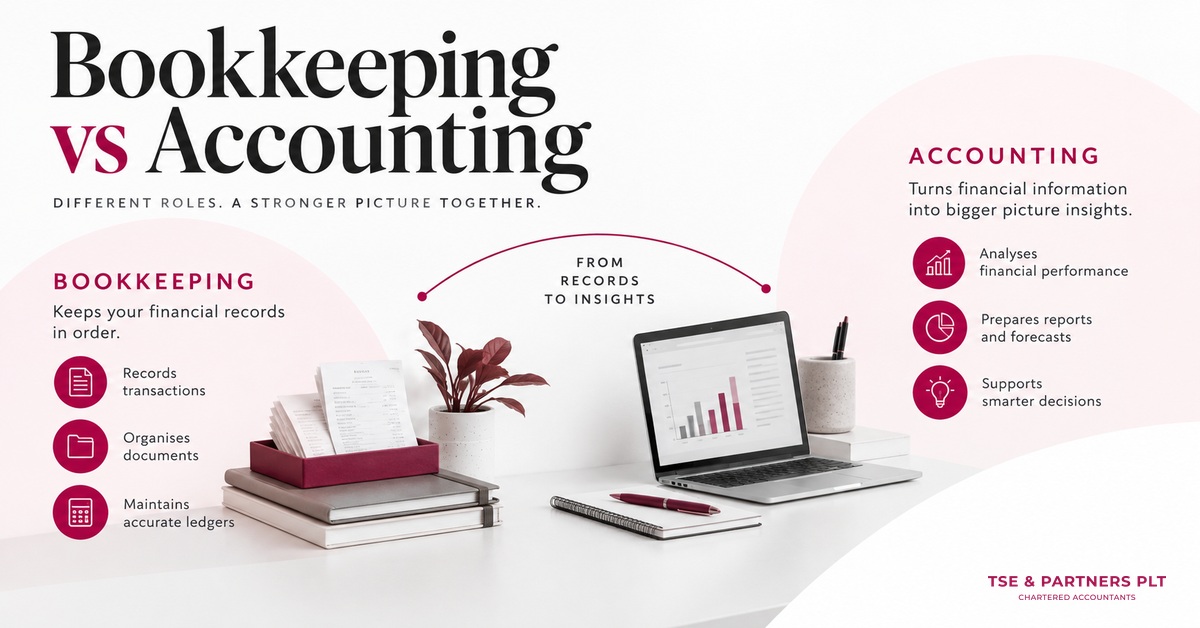
Bookkeeping captures and organises daily financial activity, while accounting reviews that information and turns it into reports, adjustments, and explanations. Bookkeeping helps show what was recorded. Accounting helps explain what the completed records mean. The 2 functions depend on each other, and one provider may perform both under a clearly agreed scope.
| Area | Bookkeeping | Accounting |
|---|---|---|
| Main purpose | Keep transaction records complete and organised | Review records and prepare useful financial information |
| Typical inputs | Invoices, bills, receipts, bank activity, card and gateway reports | Ledgers, reconciliations, schedules, prior reports, business context |
| Typical work | Recording, coding, filing, matching, reconciliation, follow-up | Adjustments, review, reporting, compilation, consolidation, explanation |
| Main output | Updated ledgers and lists of open items | Reports, financial statements, commentary, and review points |
| Main question | Was the activity recorded and supported? | What do the completed records show? |
The boundary can vary. What matters is that the engagement states who prepares, who reviews, and what the business receives.
Do not rely only on job titles. In a small business, the same person may perform both functions. The control comes from the documented task, evidence, and review rather than the title used. A monthly responsibility list can make the split clear:
| Work item | Preparer | Reviewer | Evidence or output |
|---|---|---|---|
| Collect source documents | Business owner | Bookkeeping owner | Complete document folder |
| Record and code transactions | Bookkeeping owner | Accounting reviewer | Updated ledgers |
| Reconcile key balances | Bookkeeping owner | Accounting reviewer | Reconciliation files |
| Post supported adjustments | Accounting owner | Named approver | Journal support |
| Prepare monthly reports | Accounting owner | Management | Reporting pack and notes |
| Track open questions | Named task owner | Management | Action and exception list |
This table can change with your team. The important point is that every step has an owner and a visible result.
What Bookkeeping Covers Each Month
Bookkeeping starts with source documents. These may include sales invoices, supplier bills, receipts, bank statements, card records, payment-gateway reports, payroll inputs, credit notes, and transfer records.
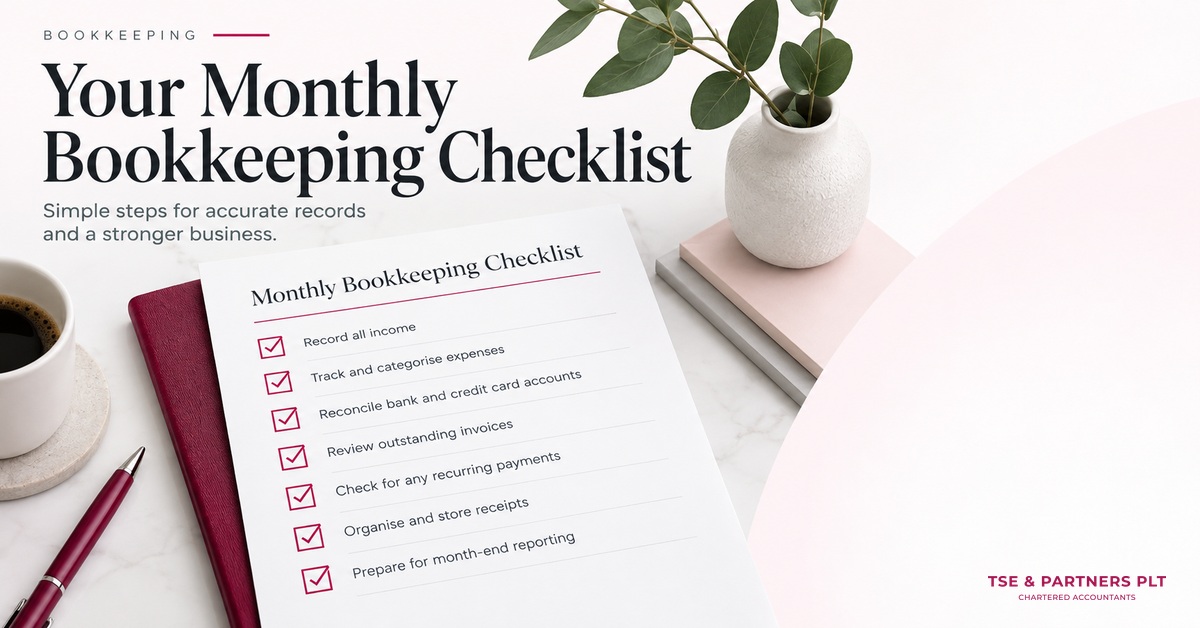
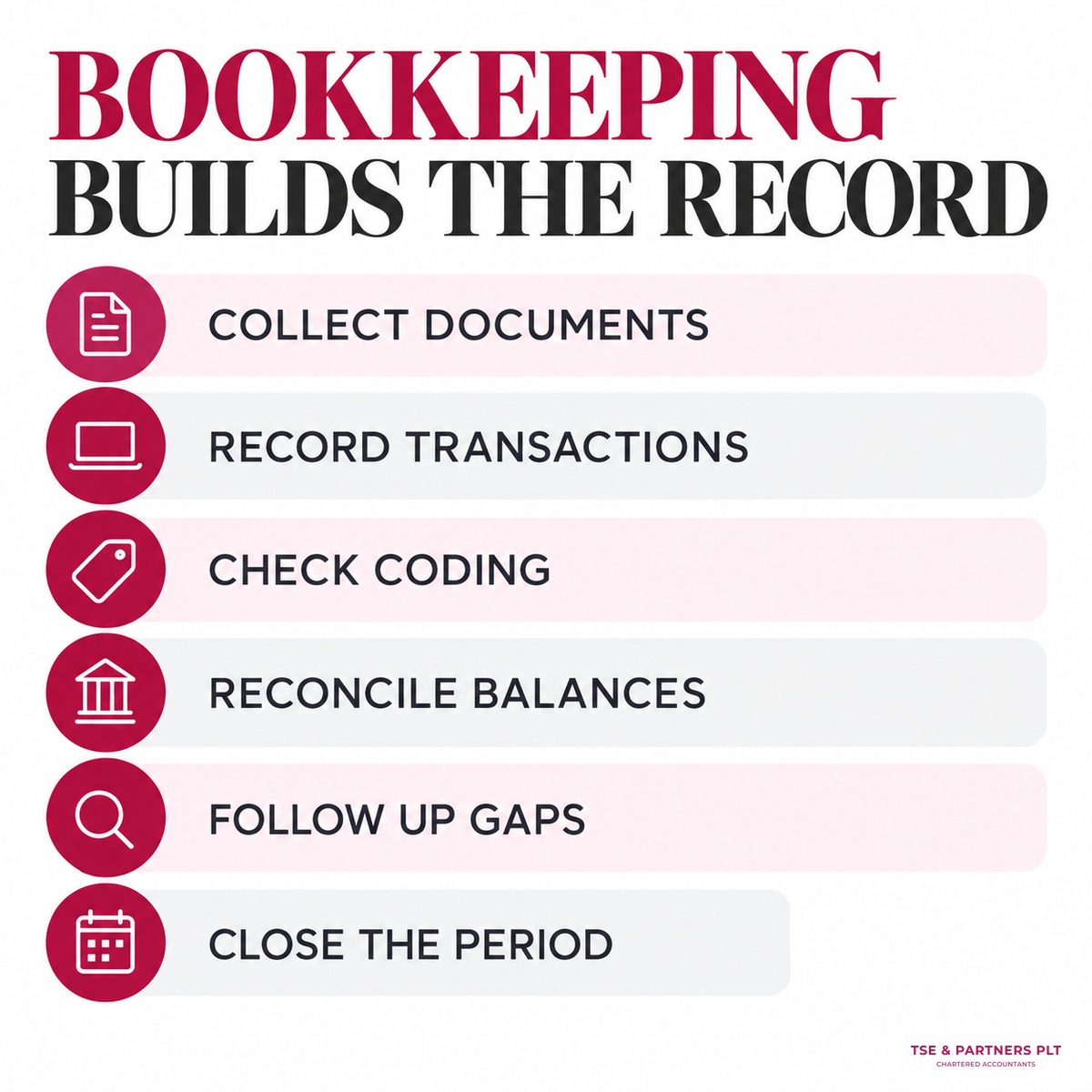
A recurring bookkeeping cycle may include:
Recording sales, purchases, receipts, payments, and supported journals.
Applying the agreed account codes and descriptions.
Matching documents to transactions.
Reconciling bank, card, gateway, and other relevant balances.
Reviewing customer and supplier balances.
Listing missing documents, unclear entries, and old open items.
Keeping records organised for the next reporting or year-end task.
Reconciliation is especially important. A ledger can be fully entered and still contain duplicates, missing fees, timing differences, or a payment posted to the wrong account. A clear bank reconciliation statement shows which differences need a book entry and which should remain open until they clear.
What Accounting Adds to the Records
Accounting begins when the underlying records are ready enough to review. The work may include checking account balances, posting supported adjustments, preparing reports, compiling financial statements, consolidating information from several entities, and explaining material changes.
For management, accounting may answer questions such as:
Did revenue, gross margin, or operating costs change from the previous period?
Is the cash balance supported by completed reconciliations?
Which customer balances are overdue?
Which supplier payments are due soon?
Are there unusual or old balances that need investigation?
Does management need a consolidated view across related entities?
A management account sample can show how reconciled records become a profit and loss view, cash summary, variance explanation, and action list.
Accounting is not automatically an audit. Preparation and compilation do not provide an independent audit opinion. If you are reviewing unaudited financial statements in Malaysia, confirm the reporting purpose, framework, responsibilities, and any separate assurance requirement.
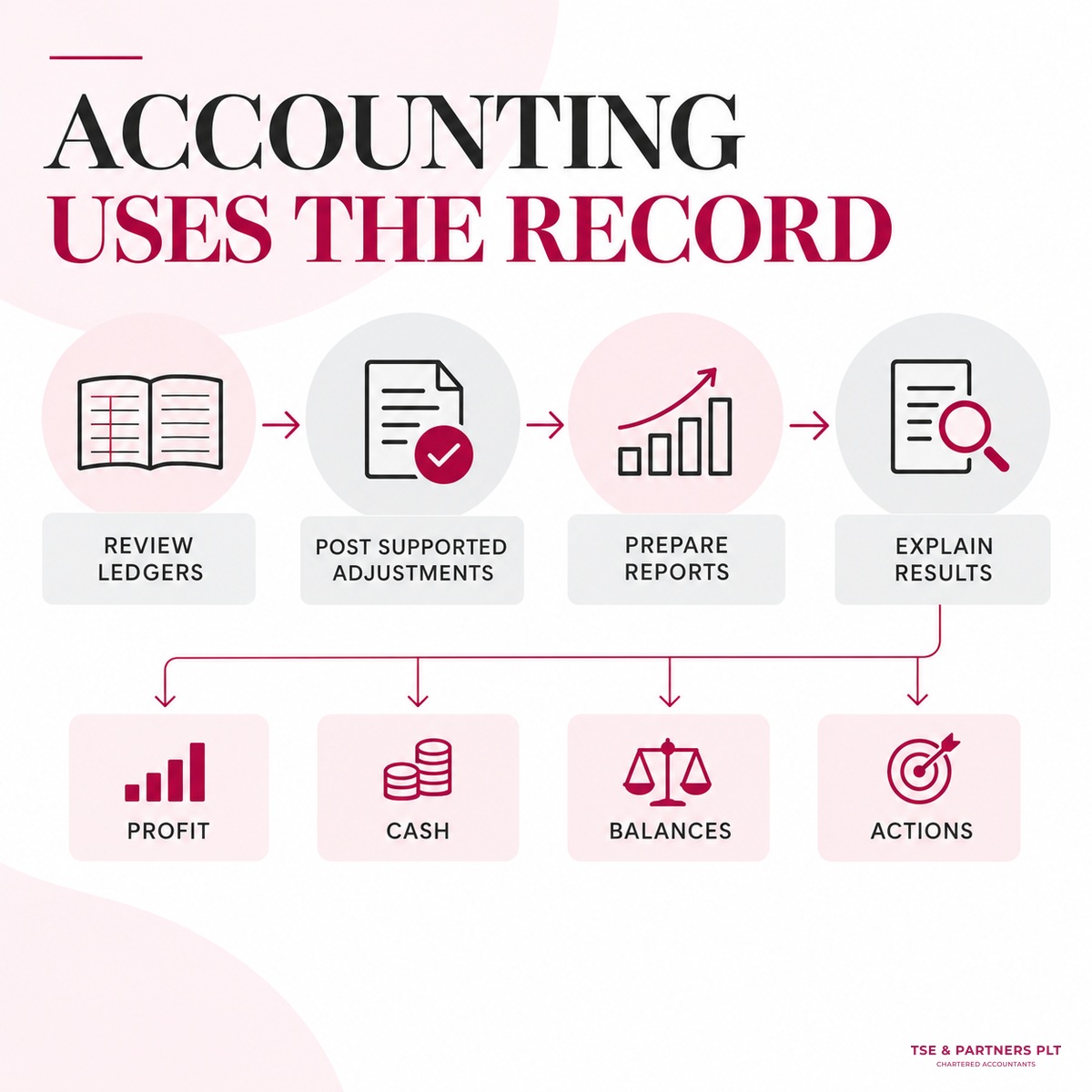
How Records Become Useful Management Reports
A clean hand-off prevents the accountant from starting with unanswered bookkeeping questions. A practical monthly flow is:
The business collects and shares the agreed source documents.
Transactions are recorded and coded.
Bank, card, gateway, customer, and supplier balances are reconciled as agreed.
Missing documents and unusual items are sent back to the named owner.
Supported corrections and period-end adjustments are posted.
Reports are prepared, reviewed, and discussed.
Decisions and open actions are recorded for the next period.
The process should not hide unresolved items. Keep a list showing the amount, first-seen date, evidence required, owner, and next action. That gives the reviewer a clear boundary between completed work and open questions.
A monthly bookkeeping checklist can help your team set the cut-off, evidence, and responsibility for every recurring task.
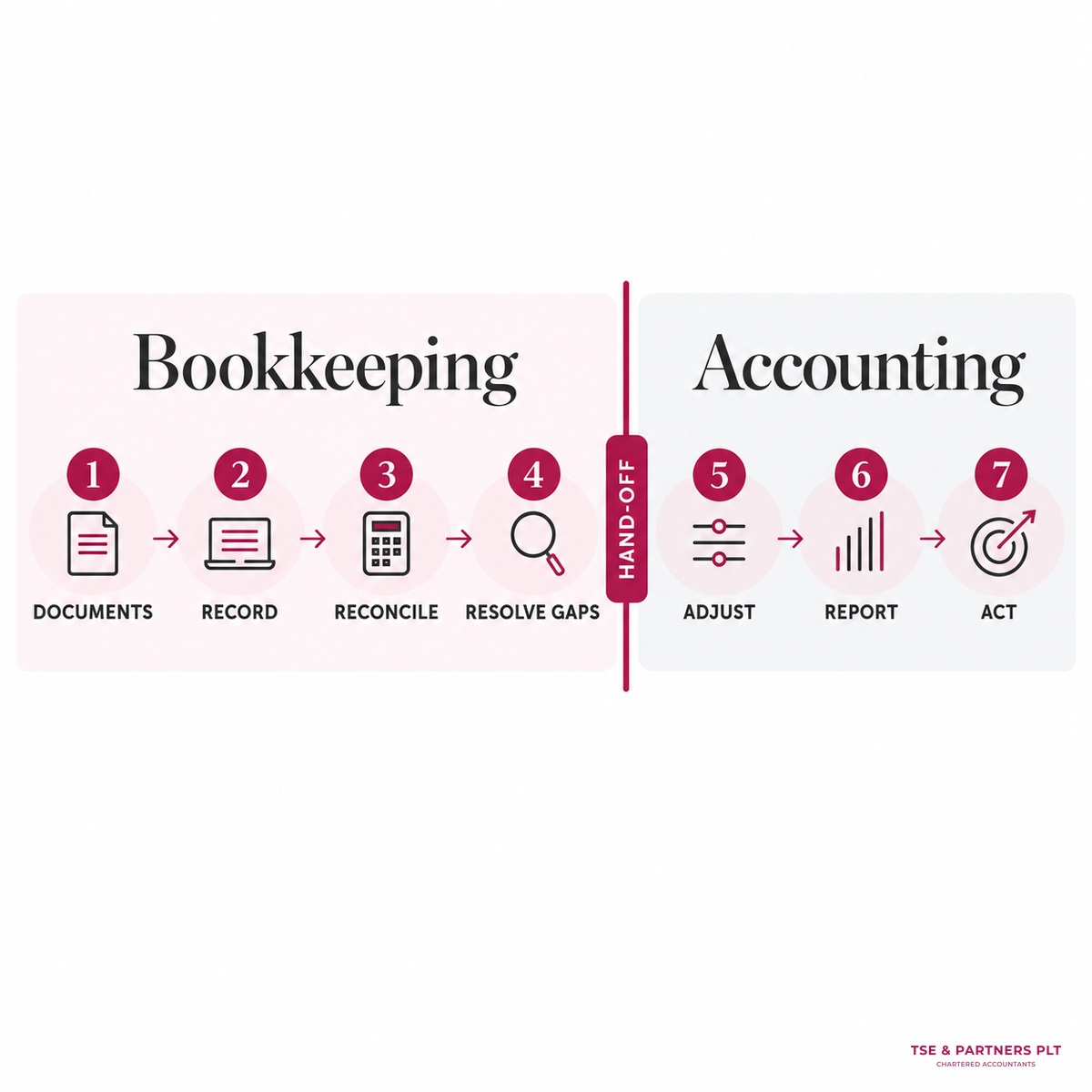
Decide What Your SME Should Outsource
Keep work in-house when your team has the time, knowledge, access, and review process to complete it consistently. Consider outside support when records fall behind, several payment channels need matching, the business has multiple entities, management needs regular reports, or no one owns the month-end close.
| Situation | A practical response |
|---|---|
| Documents arrive from many people | Name one collection owner and use one agreed submission method |
| Transactions are recorded but balances stay unclear | Add a reconciliation and review step |
| Reports arrive too late for decisions | Set a regular close date and reporting cadence |
| The business has several entities | Clarify separate records, intercompany items, and consolidation needs |
| Old periods remain unfinished | Scope catch-up work separately from recurring bookkeeping |
| The owner cannot explain what the provider does | Replace the package label with a written task and output list |
Do not outsource responsibility blindly. Your business still needs to supply records, answer questions, approve entries where required, control access, and review the outputs.
A staged approach can help when the records are behind. Start by agreeing a cut-off date and completing the oldest unfinished period. Then stabilise the recurring document and reconciliation routine. Add regular management reports only after the underlying balances are reliable enough for the decisions being made.
Keep control of system access. Use named user accounts where the software allows it, review permissions regularly, and remove access when a role or engagement ends. Decide who can create suppliers, change bank details, post adjustments, approve payments, and close a period. Bookkeeping support should not quietly become payment approval or unrestricted system control.
Agree an exception process as well. The provider should know what to do when a receipt is missing, a balance cannot be reconciled, a transaction has no clear business purpose, or management has not approved an adjustment. The safest response is usually to record the open issue, request evidence, and keep it visible until the named owner resolves it.
Finally, review the arrangement when the business changes. A new entity, sales channel, currency, loan, branch, or reporting request can change both the bookkeeping workload and the accounting review needed. Update the scope before the old process creates gaps.
Avoid Scope Gaps Before Appointing Support
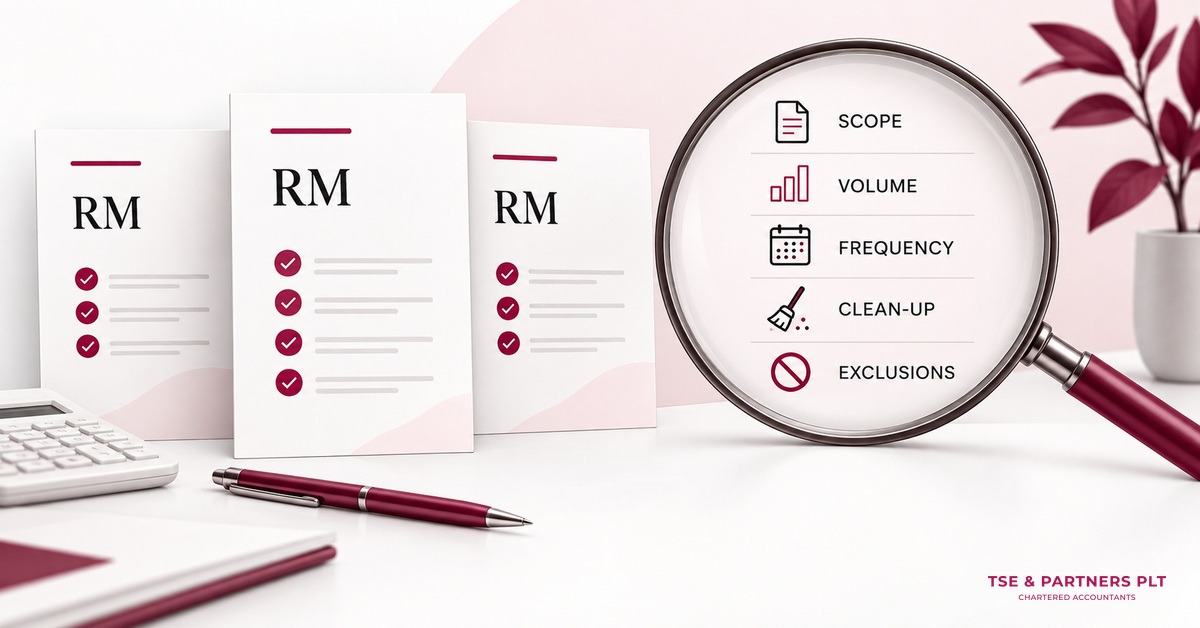
Before comparing providers, ask:
Which bookkeeping and accounting tasks are included?
Which accounts, entities, payment channels, and periods are covered?
Who collects documents and follows up missing items?
Who prepares the work and who reviews it?
Which reports or statements will the business receive?
How often will the records and reports be updated?
What software, setup, migration, or training work is excluded?
How are catch-up work and scope changes approved?
How will the business retrieve its records if the engagement ends?
Price only becomes meaningful after these points are clear. This guide to accounting service fees in Malaysia explains how volume, record quality, cadence, and one-off work affect a quote.
TSE & Partners supports accounting and bookkeeping services in Kuala Lumpur through associates. The agreed scope may include recurring bookkeeping, cloud accounting support, accounting record and workflow setup, financial statement compilation, consolidation, and related work within the verified engagement. Audit and assurance are outside this scope.
Bookkeeping and Accounting Questions SMEs Ask
Does every SME need both functions?
Most active businesses need transaction records and some form of accounting review or reporting. The amount of work and frequency depend on the business, its reporting needs, and the requirements that apply to it.
Can one provider handle both?
Yes. Ask the provider to separate the bookkeeping tasks, accounting tasks, review responsibility, outputs, and exclusions in writing.
Is bookkeeping only data entry?
No. It can also include document control, coding, ledger maintenance, reconciliation, and follow-up on missing or unusual items.
Can software replace a bookkeeper or accountant?
Software can import data, apply rules, and suggest matches. A person still needs to check evidence, review exceptions, approve changes, and explain the reports.
Does accounting support include an audit?
Not automatically. An audit is a separate assurance engagement. TSE's current accounting and bookkeeping scope excludes audit and assurance.
Data Sources and References
Xero Malaysia bookkeeping and accounting guide
Alliance Bank Malaysia SME bookkeeping guide
Grof Malaysia bookkeeping and accounting guide
Macrobyte Malaysia SME guide
ACCA research on accountants supporting Malaysian SMEs
The information in this article is general guidance only. It does not constitute accounting, tax, financial or legal advice and may not fit your circumstances. Confirm the engagement scope and seek qualified advice before acting.