Key Takeaways
- Unaudited financial statements do not carry an independent audit opinion.
- Audit exemption does not remove the duty to keep records and prepare compliant financial statements.
- For financial periods starting in 2026, Phase 2 uses RM2 million turnover, RM2 million assets, and 20 employees.
- Eligibility depends on the company, its financial periods, and the current SSM rules.
Regulatory review date: 14 September 2026
Unaudited financial statements in Malaysia may still be formal financial statements prepared under an applicable reporting framework. The word unaudited only tells you that they are not accompanied by an independent auditor's opinion. It does not mean that records, directors' responsibilities, circulation, or lodgement requirements disappear.
What Are Unaudited Financial Statements?
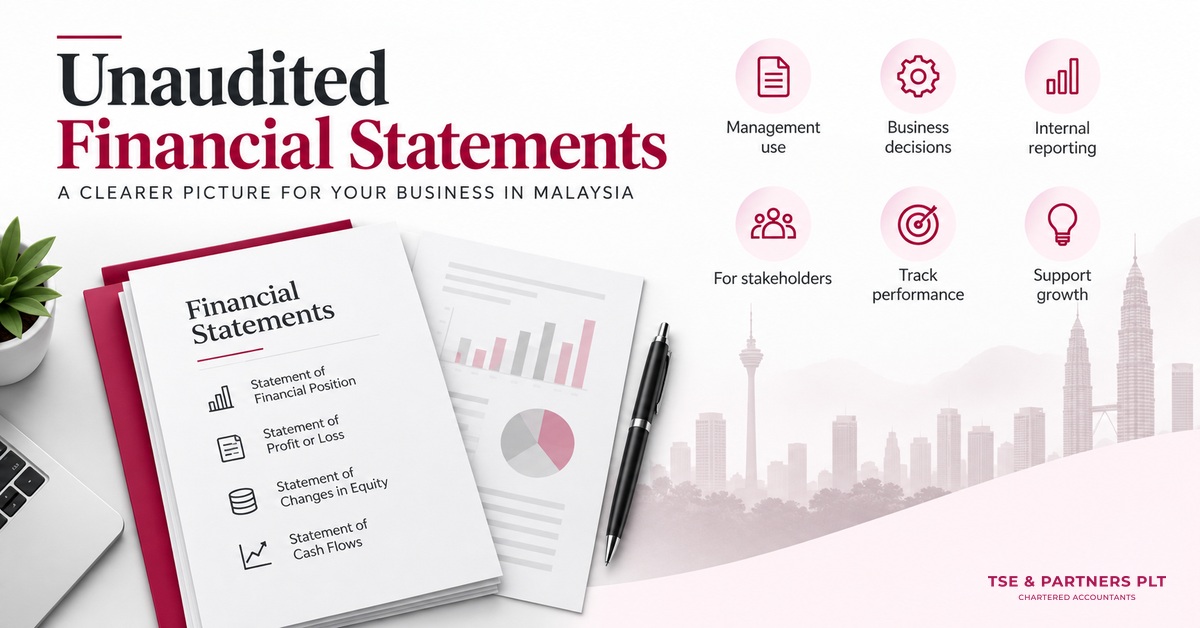
Unaudited financial statements are prepared without an independent audit opinion. Depending on the reporting framework and purpose, they may include financial position, profit or loss, cash flows, changes in equity, and notes. They can still require careful preparation, review, approval, circulation, and lodgement. Unaudited does not mean informal, regulator-approved, or automatically exempt from audit.
Separate Preparation, Compilation, and Audit
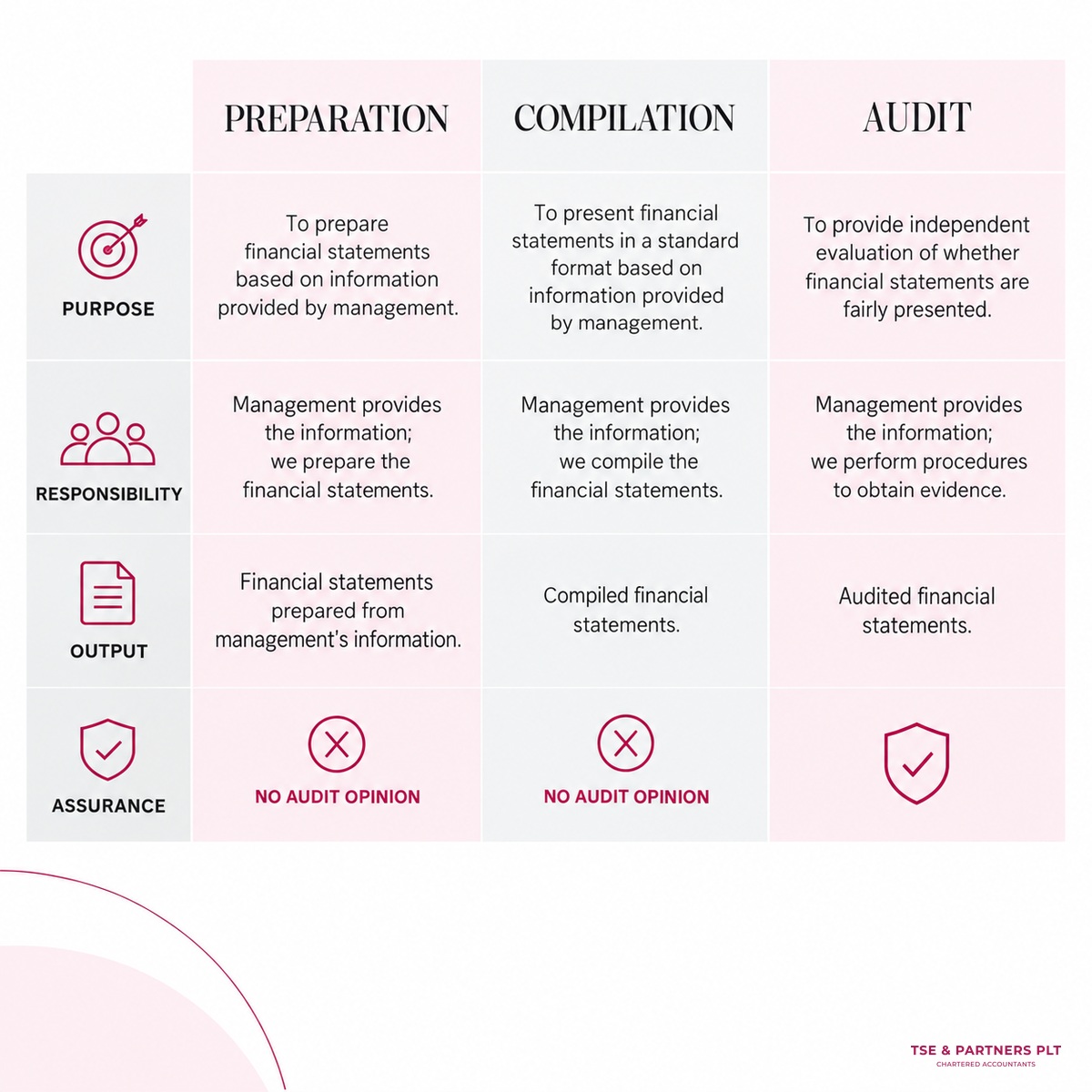
Preparation organises the entity's records into financial statements. A compilation engagement may involve a practitioner applying accounting and reporting expertise to help management prepare financial information. IFAC's explanation of ISRS 4410 states that a compilation provides no assurance.
An audit is different. It is an assurance engagement performed by an auditor and results in an audit opinion. A company should not describe prepared or compiled statements as audited.
Use the engagement name carefully:
| Work | Main responsibility | Typical output | Assurance provided |
|---|---|---|---|
| Preparation | Directors and management remain responsible for the information and statements | Financial statements prepared from the entity's records | None |
| Compilation | Management provides information and a practitioner applies accounting and reporting expertise | Compiled financial information and the relevant compilation report where applicable | None |
| Audit | Management prepares the statements and an independent auditor performs audit procedures | Audited financial statements and an audit opinion | Reasonable assurance within the audit framework |
A compilation is not a shortcut to an audit opinion. It may improve the organisation and presentation of financial information, but management still owns the records, judgements, and final statements. Readers should understand which service was performed before relying on the output.
Check the 2026 Audit-Exemption Criteria
SSM Practice Directive 10/2024 applies to qualifying private companies for financial periods commencing on or after 1 January 2025. The thresholds rise in phases.
| Phase | Financial period commencing | Turnover | Assets | Employees |
|---|---|---|---|---|
| Phase 1 | 2025 | RM1 million | RM1 million | 10 |
| Phase 2 | 2026 | RM2 million | RM2 million | 20 |
| Phase 3 | 2027 onward | RM3 million | RM3 million | 30 |
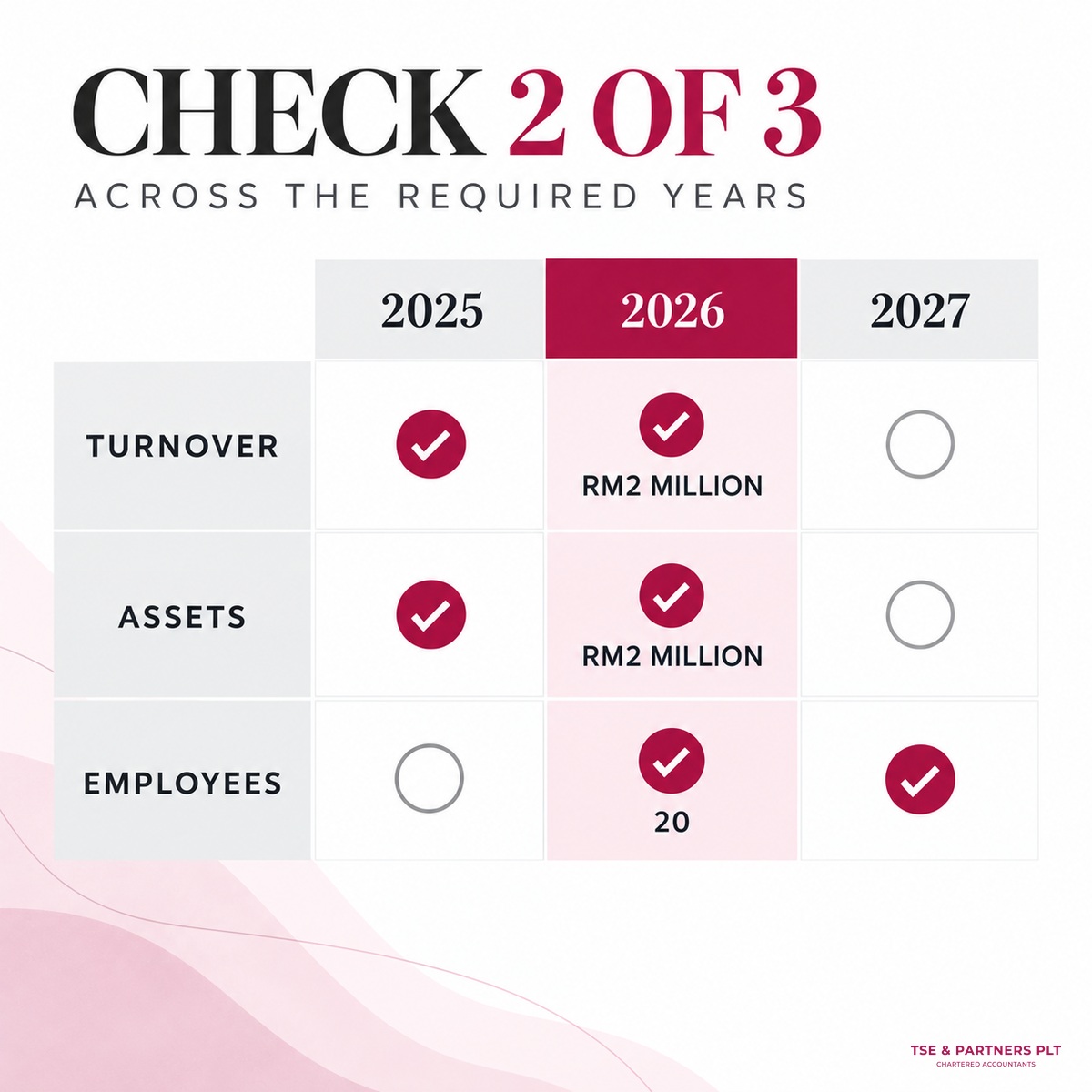
A company generally needs to meet at least 2 of the 3 applicable thresholds for the current and immediate past 2 financial years. The detailed assessment can depend on when the financial period starts and the company's history.
For an illustrative company with a financial period starting in 2026, the reviewer would identify the current year and the immediate past 2 financial years, then test turnover, total assets, and employee count for each required year under the directive. Meeting 2 thresholds in only the current year is not enough if the required prior-year test is not met.
Do not mix figures from different entities or periods. Use the company's own financial statements, ledgers, employee records, and incorporation history. Confirm how a shortened period, a newly incorporated company, or an unavailable prior year should be treated under the current SSM guidance.
Keep the calculation in the file. For every year, record the source figure, threshold used, whether the criterion was met, who prepared the test, and who reviewed it. This makes the conclusion easier to check when the thresholds or company facts change.
The framework does not apply to every entity. Public companies, private subsidiaries of public companies, and foreign companies are among the exclusions stated in the directive. A member or the Registrar may also require an audit in circumstances set by the rules.
Entity type should be checked before the numerical thresholds. A company can fall below the turnover, asset, and employee limits and still be outside the framework because of an exclusion or another applicable requirement. Audit-exemption eligibility should therefore be documented as a company-specific assessment, not inferred from one number in a management report.
Prepare the Statements and Supporting Records
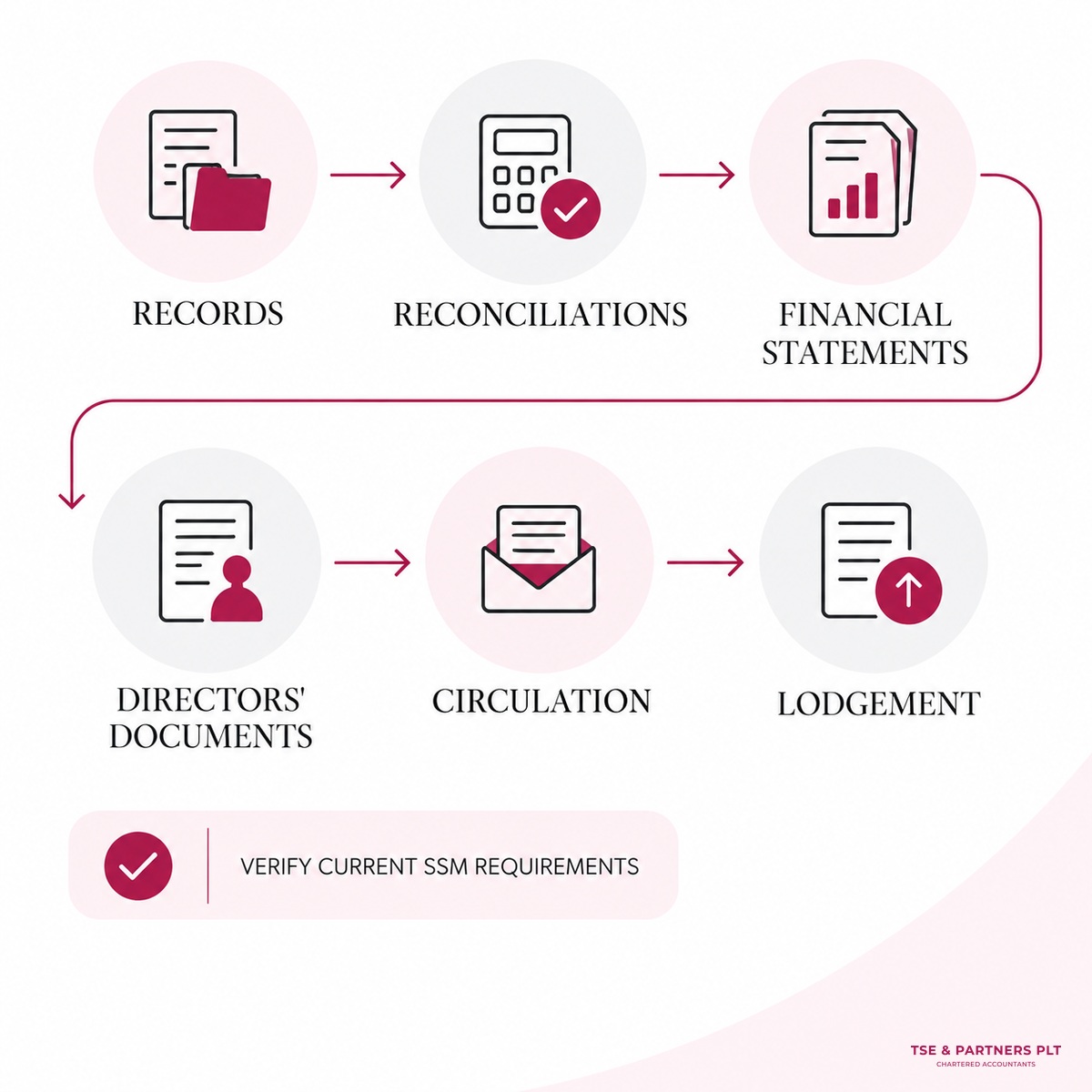
Audit exemption does not remove the need for proper accounting records. Prepare ledgers, reconciliations, invoices, contracts, bank records, schedules, explanations for material balances, and consolidation information where relevant.
SSM's current FAQ states that a qualifying company that elects audit exemption must still prepare and circulate financial statements. It must lodge the required unaudited financial statements and accompanying documents within the stated period after circulation. The statements must comply with the applicable approved accounting standards.
The FAQ updated 19 May 2026 states that the unaudited financial statements, directors' report, and certificate of compliance are lodged within 30 days after the financial statements are circulated to members. Confirm the latest filing process, document form, signatures, and company-specific deadline before submission.
Keep evidence of the circulation date because it supports the lodgement timetable. Also retain the directors' approval record, final signed documents, submission confirmation, and any correspondence about corrections. An audit exemption does not turn the filing into an informal set of management accounts.
Use this preparation checklist:
Confirm the entity and financial period.
Confirm the reporting framework.
Complete bank and other key reconciliations.
Review customer, supplier, financing, related-party, and intercompany balances.
Support material figures with schedules and source records.
Record unresolved items and judgements.
Confirm directors' review and required accompanying documents.
Check the current SSM filing method and deadline before lodgement.
Before finalising the pack, tie the statement figures back to the supporting ledgers and schedules. Check that names, registration details, dates, comparative figures, accounting policies, and accompanying reports are consistent. Record any unresolved judgement and obtain the required professional review before directors approve the documents.
A checklist supports the process, but it does not decide eligibility or prove compliance by itself. Recheck the official requirements whenever the financial period, entity structure, ownership, or applicable directive changes.
Review Eligibility Before Relying on Exemption
Do not decide from one year's turnover alone. Check the entity type, financial-period start date, turnover, total assets, employee count, current and immediate past 2 financial years, exclusions, member requests, and any direction from the Registrar.
Also ask who will use the statements. A bank, investor, grant provider, parent company, or other party may request audited information even when a statutory exemption is available. MIA guidance notes that acceptance of unaudited statements depends on each institution's policies and risk assessment.
Know Where TSE Support Fits
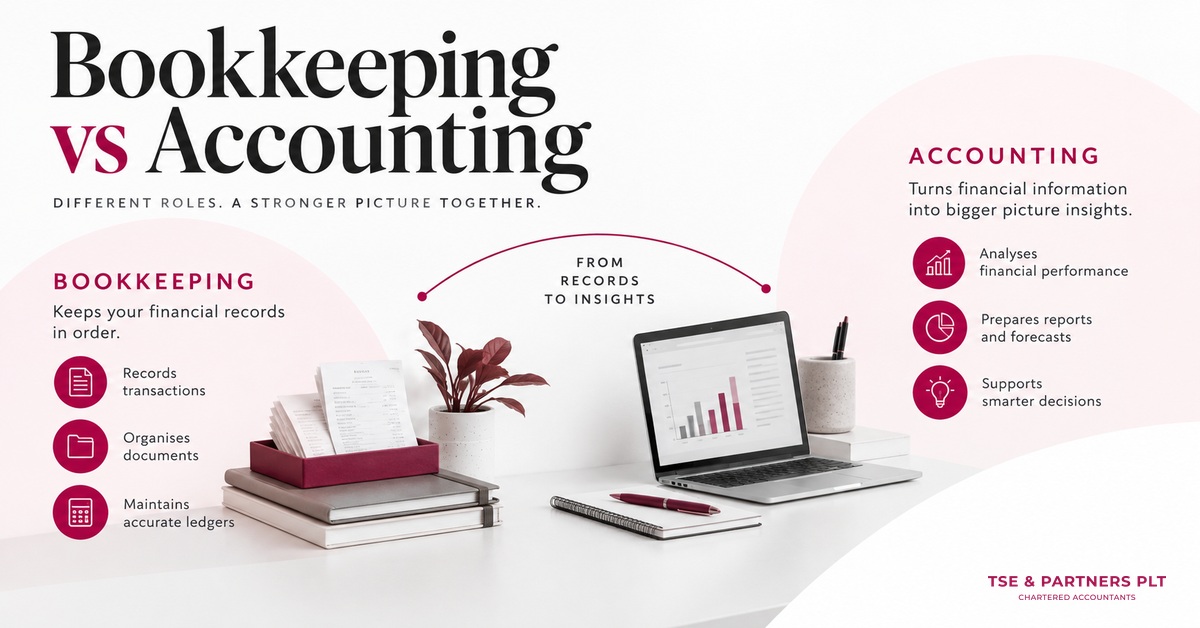
A monthly bookkeeping checklist and completed bank reconciliation statement can strengthen the preparation file. A management account sample serves a different internal reporting purpose. Understanding bookkeeping versus accounting helps separate record preparation from financial reporting.
TSE & Partners supports accounting and bookkeeping services in Kuala Lumpur through associates. The agreed scope may include bookkeeping, accounting record setup, financial statement compilation, or consolidation. Review accounting service fees in Malaysia when comparing the required records, entities, periods, outputs, and exclusions.
Audit and assurance are outside TSE's current accounting scope. Obtain advice from an appropriately qualified professional before making an audit-exemption or filing decision.
Unaudited Financial Statement Questions SMEs Ask
Does unaudited mean inaccurate?
No. It means no independent audit opinion accompanies the statements. Reliability still depends on complete records, correct preparation, review, and the applicable reporting framework.
What are the Phase 2 thresholds for 2026?
For financial periods commencing in 2026, the thresholds are RM2 million turnover, RM2 million total assets, and 20 employees. The company generally needs to meet at least 2 of the 3 criteria across the required years.
Can every private company avoid an audit?
No. The directive contains eligibility conditions, exclusions, period rules, and circumstances where an audit may still be required.
Must an exempt company still lodge statements?
A qualifying company that elects exemption must still follow the applicable preparation, circulation, and lodgement requirements for unaudited financial statements and accompanying documents.
Can TSE issue an audit opinion?
No. Audit and assurance are outside TSE's stated accounting and bookkeeping scope.
Data Sources and References
SSM Practice Directive 10/2024
SSM audit-exemption FAQs updated 19 May 2026
SSM unaudited-financial-statement lodgement guidance
Malaysian Institute of Accountants audit-exemption guidance
IFAC explanation of ISRS 4410 compilation engagements
The information in this article is general guidance only. It does not constitute accounting, tax, financial or legal advice and may not fit your circumstances. Confirm the engagement scope and seek qualified advice before acting.