
Management Accounts & Reporting Services
See income, costs, cash movement and balances during the year, with management reports shaped around the decisions you need to make.
TSE & Partners PLT offers this work to Malaysian SMEs through associates, with the report format, measures and timetable agreed before preparation starts.

What do management accounts services cover?
Management accounts services turn your business records into a regular internal report for an agreed period. It can show income, costs, cash movement, balances and other agreed measures tied to the decisions in front of you. The format, measures and timetable are set first. Associates deliver the work, and the engagement names who prepares and reviews it.
Before any figures are prepared, you and the associate agree:
- The reporting question: the decisions the report needs to support.
- The period and cycle: a monthly pack, or another reporting cycle you agree.
- The measures: which income, cost, cash, balance or other figures the pack includes.
- The format and timetable: how the pack is set out and when each one is due.
- The review points: who is responsible for reviewing the pack.
The pack is shaped around your business, so there is no fixed template. To see one illustrative layout first, this management account sample walks through the sections a pack can contain.
Agree what your management report needs to show
Start with the business question, then agree the figures and level of detail. These examples describe the income, cost, cash and balance measures within this service; they are not a fixed package.
Scroll sideways to see all columns.
| Owner question | Figures to agree | Why it matters |
|---|---|---|
| How did the period perform? | Income and costs for the reporting period | See the result behind day-to-day activity rather than wait for year-end. |
| Why does cash feel different from profit? | Cash movement and relevant balances | Look at cash alongside the period result instead of treating them as interchangeable. |
| Which figures need follow-up? | Agreed measures and clearly identified unsupported or unfinished items | Know which questions need records or explanations before relying on a figure. |
| Can we compare one period with another? | A consistent format and definitions on the agreed reporting cycle | Make changes easier to recognise without changing what a heading means each month. |
When owners start asking for management accounts
This service is for owners and directors of owner-managed and growing SMEs, in Kuala Lumpur and across Malaysia, who need to see their figures during the year. You may recognise one of these situations:
- Reports arrive too late to help with the decision they were meant to inform.
- Profit looks healthy, but the bank balance tells a different story.
- Transaction volume has grown, and the owner no longer sees the numbers as often.
- Costs that are paid once a year make one month look much worse than the rest.
- Nobody is sure who owns the step between recording transactions and reporting on them.
If one of these sounds familiar, it may be time to agree what your figures should show and how often you need to see them.
Choose the right report for the job
Management accounts are internal reports for owners and directors. They are not the business's annual financial statements, and the engagement has clear limits:
- It does not prepare financial statements. Financial statements and supporting schedules agreed for a financial period belong to Financial Statement Preparation.
- It does not consolidate the results of a group. Group figures belong to Consolidated Accounts.
- It gives no audit opinion and no assurance.
- It does not include forecasts, budgets or virtual CFO advice.
- It informs decisions but does not make them. Those stay with the owners and directors.
Management accounts and annual financial statements also have different readers and are prepared at different times.
Reliable reports start with reconciled records
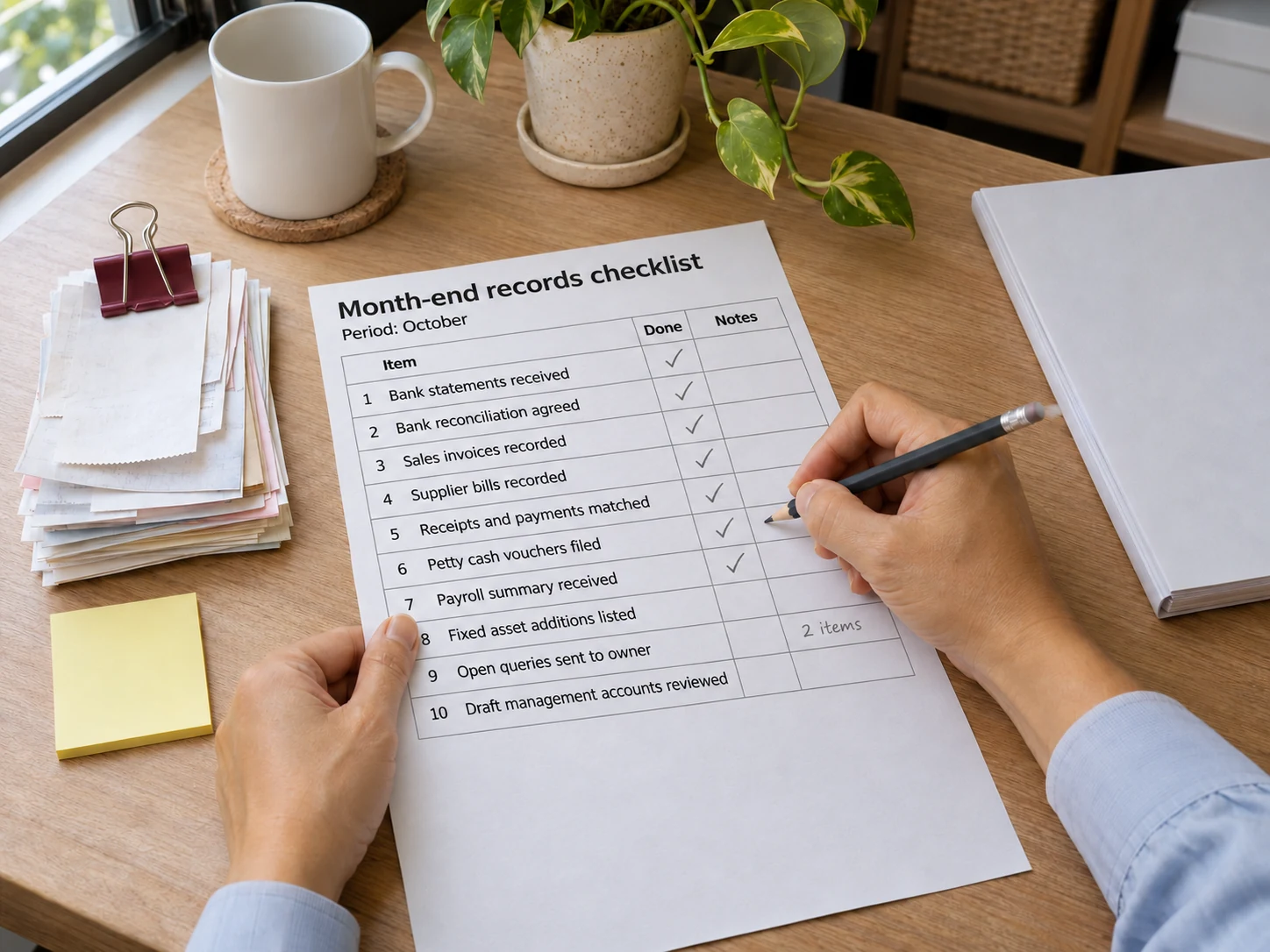
A management report is only as dependable as the records behind it. Before you rely on a pack, check 3 things:
- Bank balances agree with the books for the period.
- Documents for the period were collected by an agreed cut-off date.
- Open items, such as missing receipts or unexplained balances, are listed with a named owner.
If these checks are not in place, the cash and balance figures can mislead. That is why the associate looks at your record position before the report format is agreed. A useful pack also labels any figure that rests on missing support or an unfinished reconciliation, so you know how far to rely on it.
A monthly bookkeeping checklist sets out a routine that keeps records ready for reporting. Understanding bookkeeping versus accounting also shows where recording ends and reporting begins.
Day-to-day recording is covered by the bookkeeping work on the main accounting and bookkeeping services in Kuala Lumpur page. Your engagement states which records work sits alongside the reporting. If earlier periods are still unfinished, Catch-Up Bookkeeping & Accounts Clean-Up is the service for bringing them up to date first. Regular reports are best added once the balances underneath them are reliable.
How a management reporting engagement runs
- STEP 01
Name the decisions ahead
Share which company and period you need reports for, and which questions the figures should help you answer.
- STEP 02
Check the records behind the figures
The associate looks at the records available, how far the reconciliations have gone and which items are still missing.
- STEP 03
Agree the pack and who reviews it
Together you set the format, measures, reporting cycle, timetable and review points. The engagement names the associate preparing the work, the responsible reviewer and your customer-facing contact.
- STEP 04
Prepare the pack and go through it
The associate prepares the pack from the agreed records. It is reviewed as agreed, and you then go through the outputs with your named contact.
Timings depend on when records arrive and how complete they are. They are set in the engagement rather than promised in advance.
Choosing a reporting cycle that fits your business
Start with whether you need figures every month. The answer depends on how the business runs:
- Monthly management accounts can suit a business that makes regular decisions on cash, margins, customers or costs.
- A longer interval can suit a business with fewer transactions that acts on a wider view.
- If records tend to arrive late, the timetable needs to allow for that, or the records need attention first.
Whichever cycle you choose, keep the layout the same each period. When headings and definitions stay put, changes are easier to spot. The cycle is agreed in your engagement, and it is worth revisiting when the business changes.
What shapes the fee for management accounts
There is no single published price. The fee follows the scope agreed with you after the associate has reviewed your records. These factors usually matter most:
| What is assessed | Why it affects the scope |
|---|---|
| Companies involved | Each company has its own records to work from, so more companies mean more work. |
| Record condition | Unreconciled balances or missing documents need work before the figures can be relied on. |
| Reporting cycle | A monthly pack means more preparation and review rounds in a year than a longer cycle. |
| Measures and detail | Each extra measure or level of detail adds preparation and review time. |
| Records work agreed alongside the reporting | How much recording and reconciliation is included changes the work involved. |
The associate can explain the fee once the scope is clear.
Questions about management accounts services
How are management accounts prepared?
Preparation starts with the records for the agreed period and a clear view of reconciliation progress and open items. Share how your team keeps the records and which period is complete. The associate reviews that starting point before agreeing the reporting scope. The engagement should distinguish report preparation from any additional records work.
What are management accounts?
Management accounts are internal reports of financial performance and position for an agreed period. Their format and reporting cycle are set around the business’s decision needs and available records, rather than a fixed statutory package.
What is the main purpose of management accounting?
For this reporting service, the purpose is to give owners and directors useful internal figures for decisions during the year. Reports use the agreed records and cycle. Budget preparation, forecasts and virtual CFO advice are outside this service, even though the wider management accounting profession can cover those activities.
What is included in management accounts?
The pack can show income, costs, cash movement, balances and other measures agreed for your business. Ask for the proposed headings, reporting period and review arrangements before work starts; not every business needs the same pack.
What are examples of management accounts?
Our management account sample illustrates a possible report layout and how figures can be arranged for review. Use it to discuss which headings and comparisons you need; it is an illustration, not a guaranteed standard package.
Is a P&L the same as management accounts?
No. A profit and loss statement shows income and costs for a period. A management reporting pack can also include cash movement, balances and other agreed measures, so it is not necessarily limited to a single P&L.
How much does management reporting cost?
The fee depends on the reporting cycle, transaction volume, condition of the records and the measures in the pack. Share your latest accounts and the decisions you need the reports to support so the associate can scope the work.
Can reporting start if our bookkeeping is behind?
The starting position needs to be clear first. Missing transactions and unreconciled balances can affect the reports. Identify the unfinished periods when you enquire so catch-up work and the ongoing reporting cycle can be scoped separately.
Does the service include budgets or forecasts?
No. This service prepares internal reports from the agreed records. Forecasts, budget preparation and virtual CFO advice are outside the scope. If an existing budget is to be used for comparison, discuss the available figures and the intended report first.
Is a management account the same as a financial statement?
Management accounts are internal reports for owners and directors. They follow a format and cycle agreed for your business and focus on the decisions ahead. Annual financial statements are a formal year-end package with a different purpose and readership. The figures can also differ, for example where adjustments are made at year-end.
How often are management accounts prepared?
It depends on how often you make decisions that need the figures, and how soon your records are complete after each period ends. The cycle is set in your engagement and is worth revisiting as the business changes.
What records are needed before preparing management accounts?
Start with bank statements, sales and purchase records, expense documents and any trial balance or earlier reports. The associate also needs to know how far reconciliations have gone and which items are still open. The final list depends on the agreed scope.
Are management accounts audited?
No. Management accounts are internal reports and carry no audit opinion or assurance. Audit and assurance work is not part of this service.
Who prepares and reviews the reports?
The work is delivered through associates. Your engagement names the associate who prepares the reports, the person responsible for reviewing them and the contact you deal with. It also sets out the records required and the outputs you receive.
Related accounting and bookkeeping services
Accounting & Bookkeeping
Explore ongoing bookkeeping, full-set accounts and the right reporting support for your business.
Financial Statement Preparation
A formal financial statement package for an agreed period, prepared from complete accounting records.
Consolidated Accounts
One set of group figures across related companies, for businesses that operate through more than one entity.
Catch-Up Bookkeeping & Accounts Clean-Up
For periods with unfinished or incomplete records that need to be brought up to date.
Explore management accounts and reporting
See how income, costs, cash and balances can be organised in our management account sample. Use the monthly bookkeeping checklist to prepare the records behind the report.
What to prepare before you get in touch
Gather what you can before you send a message:
- The company name and the period you want reports for.
- The decisions the reports need to support.
- Any current reports, trial balance or management figures.
- How far bank and other reconciliations have gone.
- Whether more than one company is involved.
- The reporting cycle you have in mind.
Send only records you have permission to share. The associate will tell you if anything else is needed.
Talk to TSE & Partners about management reporting
Send the company name, the period and the decisions you need figures for. TSE & Partners PLT can then explain how an associate-delivered reporting engagement could be scoped, once your records have been looked at.