Key Takeaways
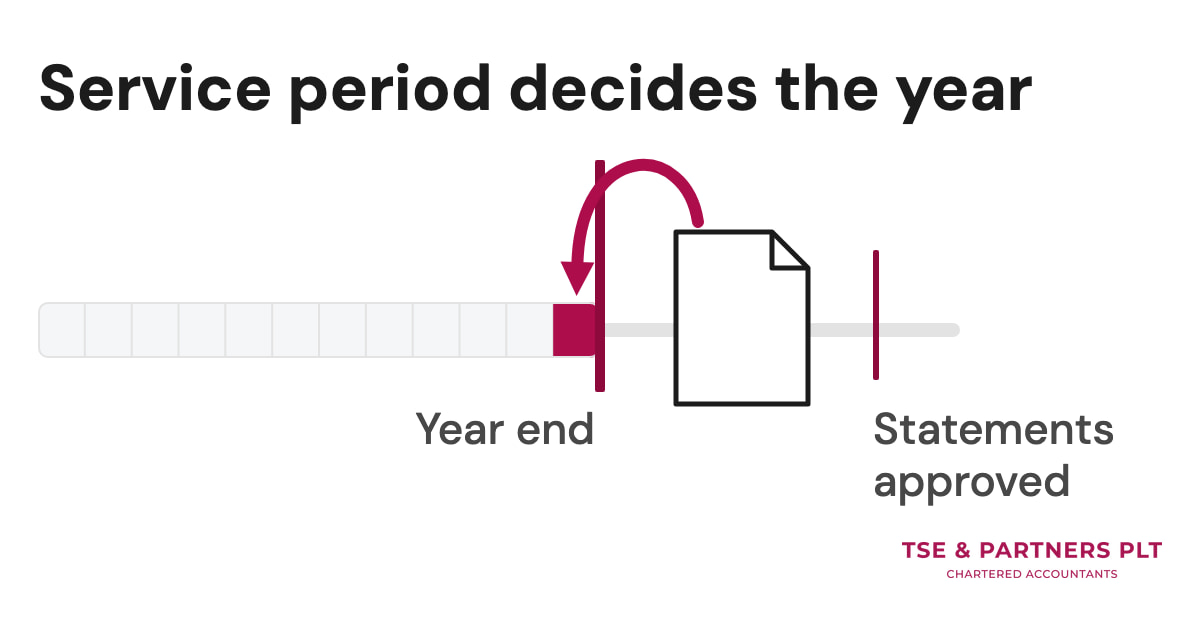
- An invoice dated after year end can still belong to the year that ended. What counts is when the goods or services were received.
- Check whether the cost was already recorded at year end as an accrual. If so, adjust only the difference.
- A contract or service that starts after year end belongs to the next year.
- A bill that arrives after the statements are approved is not automatically an error. It depends on whether the information was available, and reasonably obtainable, before approval.
Your financial year has closed, and supplier invoices keep arriving after year end. Your preparer (the accountant who puts the financial statements together) will ask for them. You need to know which ones change the year that ended, and what to do if one turns up after the statements are approved.
Sorting these bills is a routine part of financial statement preparation. A bill in the wrong year misstates that year's expenses and profit, and a cost already recorded at year end can be counted twice.
This guide covers supplier bills you receive, not invoices you issue. It does not cover tax or e-Invoice rules.
For other year-end questions, see how to read financial statements and what to do when a stock count takes place after year end.
Which year does a late supplier invoice belong to?
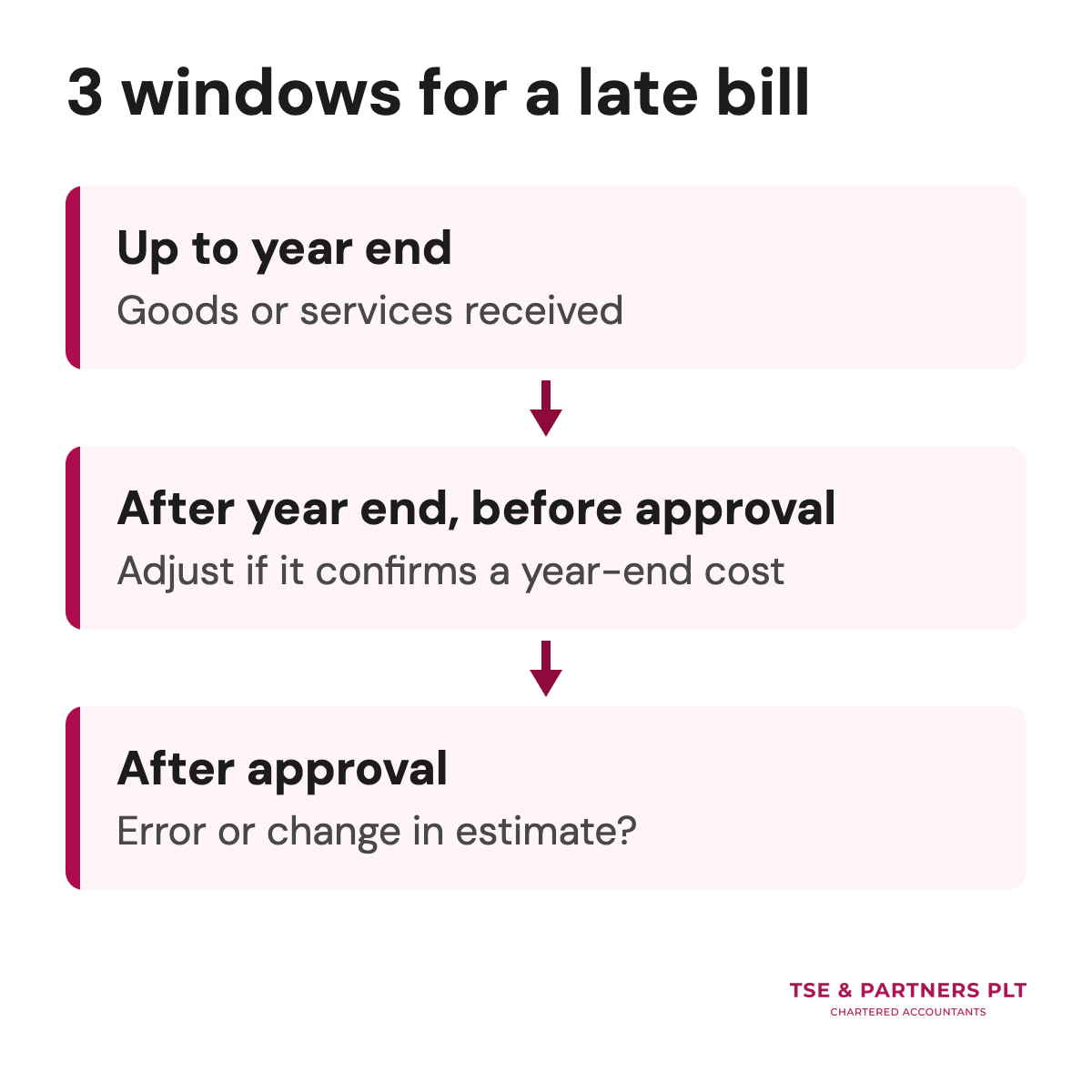
For goods or services already received, a supplier invoice belongs to the financial year in which they were received and your obligation to pay arose. The invoice date, the date it reaches you and the payment date do not decide this on their own. An invoice arriving after year end may bill a cost that already belonged to the year.
Timing matters too. Until the statements are approved for issue (the Standard says "authorised for issue"), a late bill that confirms a year-end cost is added to that year (paragraphs 32.2 to 32.4). After approval, the question becomes whether the original figure was an error or a reasonable estimate.
Why the invoice date alone does not decide the year
Financial statements, apart from cash flow information, are prepared on the accrual basis. A cost is recorded in the period it is incurred, even if it is paid later (paragraph 2.36 of the IFRS for SMEs Standard, explained below, and the IFRS Foundation's training notes on it). Something the company owes is a liability: a present obligation arising from past events (paragraph 2.15(b)). If a supplier finishes work in March, the obligation exists in March. The April invoice is the paperwork for it. Not every such bill is an expense straight away, though. Goods bought as stock, and equipment, are first recorded as assets, and an amount paid in advance for a later service is not yet an expense.
Your preparer may use 3 terms for amounts owed to suppliers. IFRS Foundation training material explains them (guidance, not part of the Standard):
Trade payable: goods or services received, and invoiced or formally agreed with the supplier.
Accrual: goods or services received, but not yet paid for or formally agreed with the supplier, for example because the invoice has not arrived. The amount sometimes has to be estimated.
Provision: a liability with more uncertainty about its timing or amount than an accrual.
Choosing the year and the type is accounting judgement. Your preparer works it out and advises you, but your directors remain responsible for the financial statements and approve them. See bookkeeping versus accounting for how that differs from entering bills.
Which reporting framework applies?
The example assumes the company uses MPERS 2016 and has not applied MPERS 2025 early. MPERS 2025 applies to annual periods beginning on or after 1 January 2027, with earlier application permitted. Ask your preparer how the framework your company uses applies to the invoice and the financial statements. MPERS 2016 vs MPERS 2025 explains when the new edition starts.
Sorting 4 late supplier invoices into the right year
Late bills rarely arrive sorted. In this hypothetical case, four supplier invoices, D1 to D4, arrive after year end but before approval. They total RM5,630, but only RM2,200 is added to the year that ended.
A Kuala Lumpur trading company's financial year runs from 1 April 2025 to 31 March 2026. Its directors approve the statements for issue on 31 July 2026. Every bill is for administrative services already used up, so each cost is an expense rather than part of stock or equipment.
All prices are agreed contract prices. Before any late bill arrives, the draft statements already include two year-end accruals totalling RM1,460. These are RM980 for March office cleaning at the monthly fee, and RM480 for a records-disposal collection on 27 March. Disposal is billed at RM1.20 per kg after weighing, so the RM480 is an estimate of 400 kg, based on the last three collections.
| Invoice | Service period covered | Reason | Effect on year to 31 March 2026 |
|---|---|---|---|
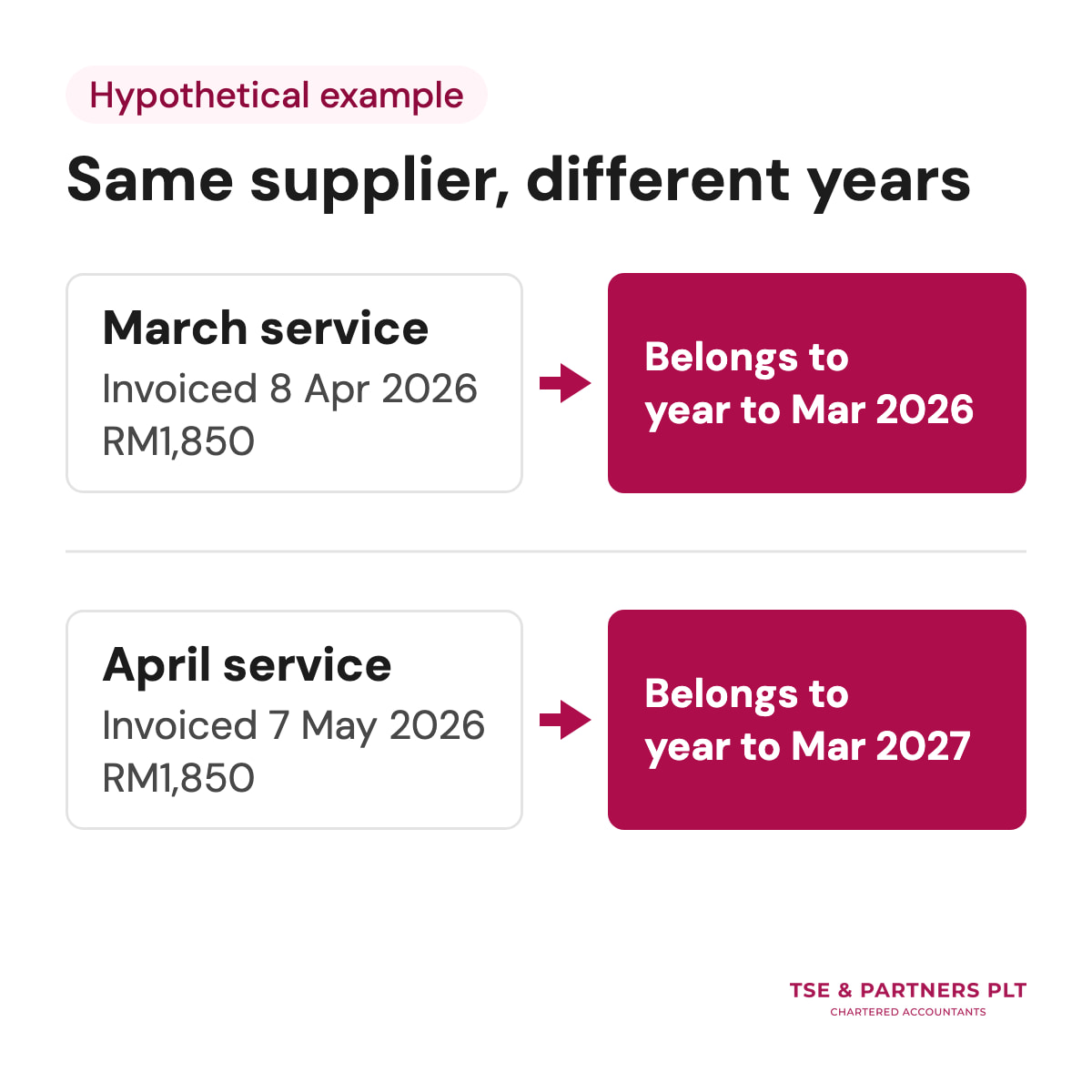
| D1: IT helpdesk, dated 8 April 2026, RM1,850 | March 2026 support, stated on the invoice | Service received before year end | Add RM1,850 |
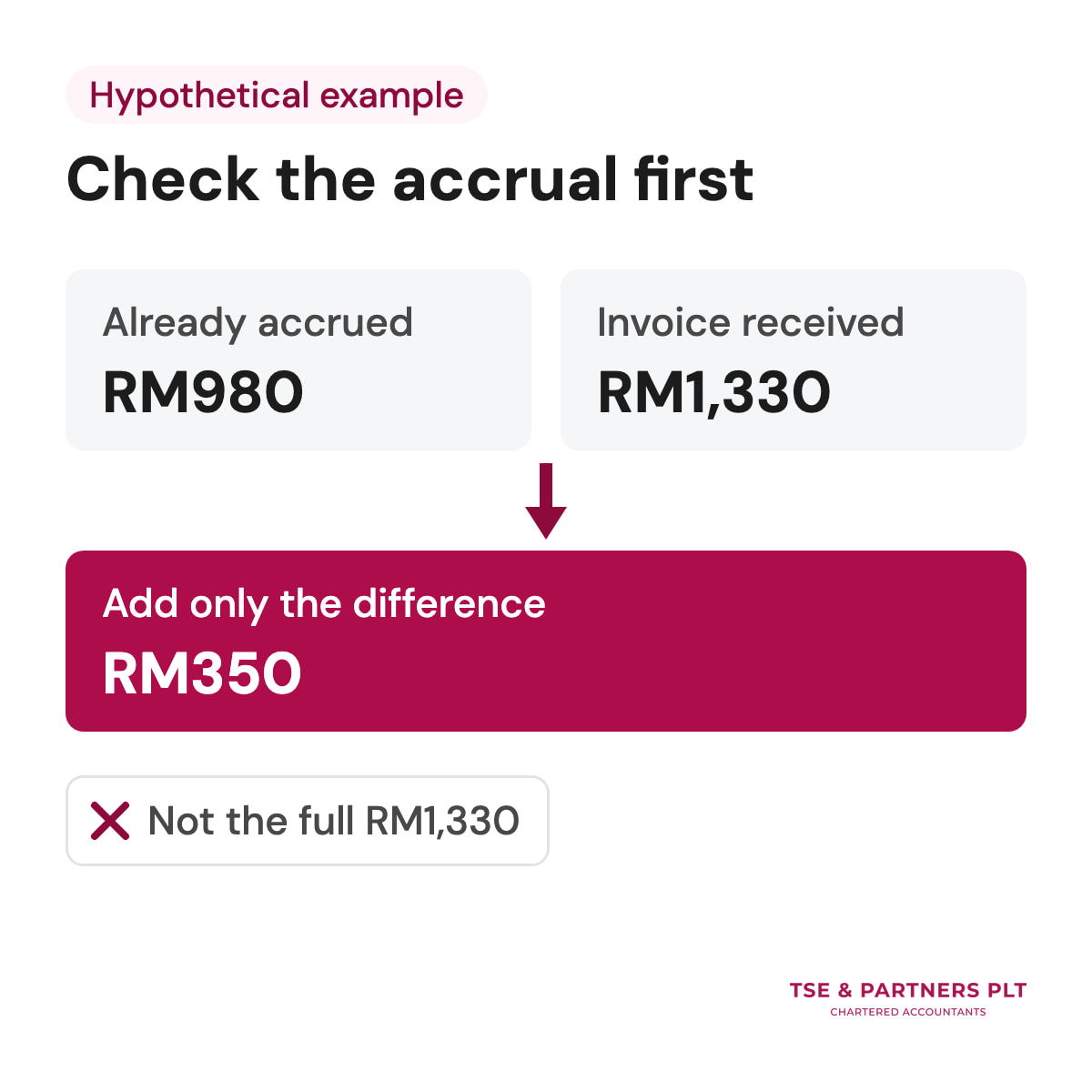
| D2: Cleaning, dated 6 April 2026, RM1,330 | March fee of RM980, plus a deep clean done on 28 March 2026 at the company's request, RM350, backed by a signed service note dated 28 March 2026 | Both services received before year end. RM980 already accrued | Add RM350 only |
| D3: IT helpdesk, dated 7 May 2026, RM1,850 | April 2026 support, stated on the invoice | Service received after year end | None |
| D4: Records archiving set-up fee, dated 30 April 2026, RM600 | New contract signed 14 April, set-up done 20 April 2026 | New contract after year end | None |
In the Standard's terms, receiving D1 is an adjusting event: it gives evidence of a cost that existed at year end, so the year-end figures are adjusted (paragraphs 32.2 and 32.4). D4 is a non-adjusting event. The contract was signed after year end, so the year-end figures stay as they are (paragraph 32.6).
Administrative expenses for the year rise by RM2,200 (RM1,850 for D1 plus RM350 from D2), and profit before tax falls by the same amount. Of the RM5,630 billed in D1 to D4, RM980 was already accrued, and D3 and D4, RM2,450 together, belong to the year ending 31 March 2027. For your own bills, D1 and D3 are the pair to remember: same supplier, same RM1,850, different years.
Check existing accruals so a cost is not counted twice
D2 shows the risk. RM980 of its RM1,330 is already in the draft as an accrual. Recording the full invoice as well makes March cleaning RM2,310, overstating it by RM980.
Before adding a late invoice, compare it with the accruals already recorded for the year:
Supplier: is there a year-end accrual for this supplier?
Period: does it cover the same period or job?
Amount: what was accrued, and what does the invoice show?
Difference: adjust only the difference, up or down.
Leftovers: an accrual with no matching invoice stays until your preparer confirms the amount is no longer owed.
In the example, accruals rise from RM1,460 to RM3,660: RM1,330 for cleaning, RM1,850 for IT support and RM480 for records disposal.
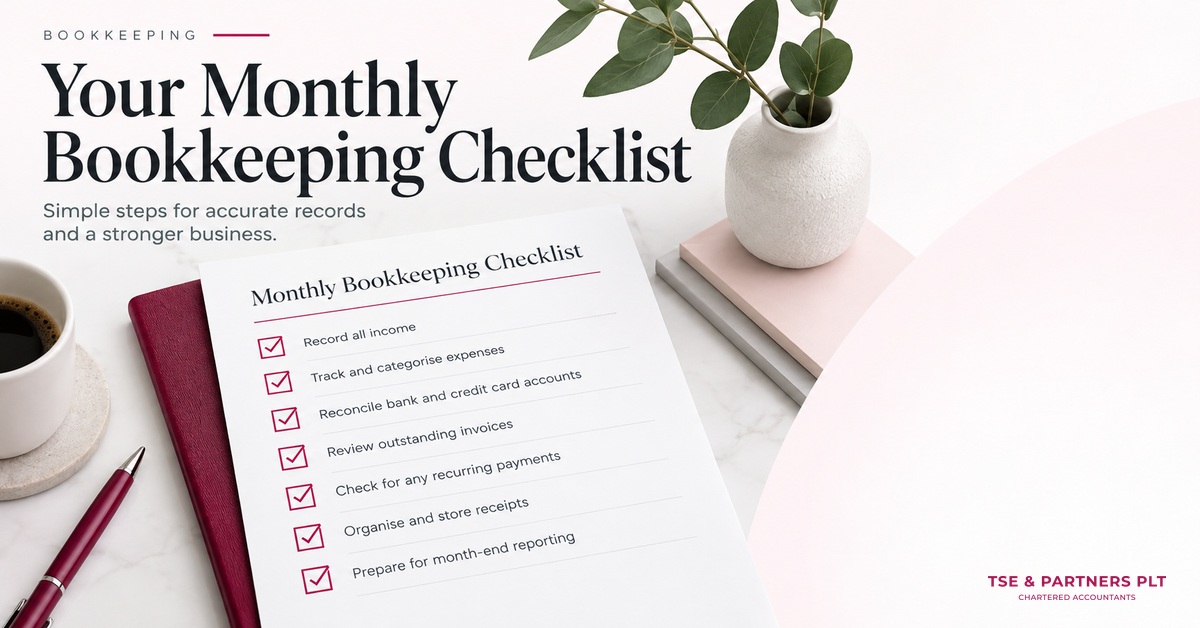
Filing supplier bills each month, as part of a monthly bookkeeping checklist, makes this match quicker at year end. Directors can then check the accruals figure in the draft against the company's own list of accruals, one of the steps in what to check before signing financial statements.
What if a bill arrives after the statements are approved?
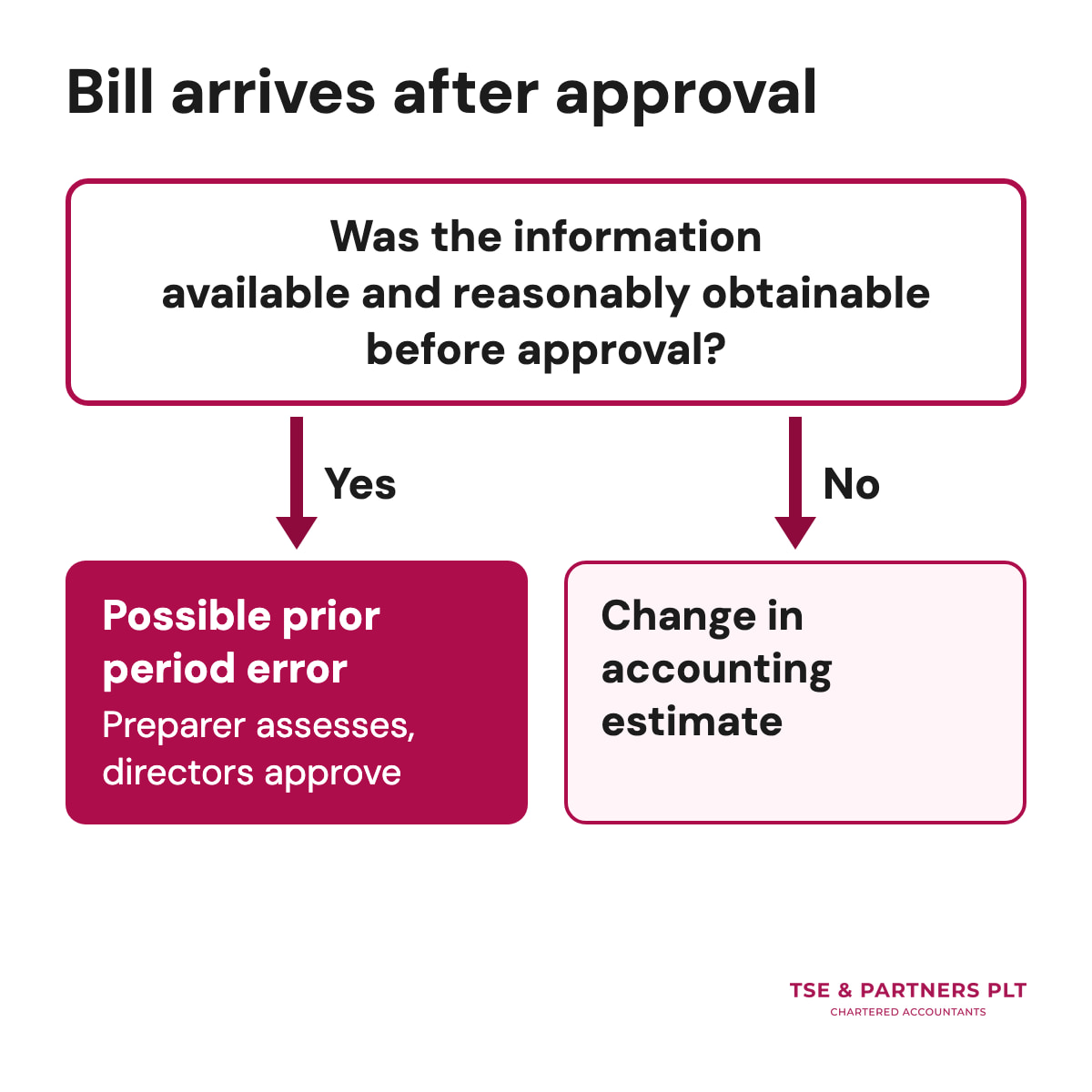
It is not automatically an error. It depends on whether the information was available, and could reasonably have been obtained, before approval.
D5 shows how this works. It is the disposal invoice for the 27 March collection, dated 2 September 2026, after the directors approved the statements on 31 July. At 520 kg it comes to RM624, which is RM144 more than the RM480 accrual. Had it arrived before approval, the accrual would simply have become RM624, and total accruals RM3,804. Arriving after approval, the same RM144 is treated in one of two ways, depending on when the weight was known.
If the disposal weight was emailed in March
The supplier weighed the load on 30 March 2026 and emailed the weighbridge ticket, showing 520 kg, to the company's general inbox on 31 March. Nobody forwarded it. The weight was available before approval and could reasonably have been obtained. That points to a possible prior period error: a mistake in statements already approved, which can include an oversight (paragraphs 10.19 and 10.20).
This does not automatically mean restating the statements. Only a material error must be corrected by restating the earlier figures. An error is material if it could influence the decisions of people using the statements. The restatement is made, to the extent practicable, in the first statements approved after the error is found (paragraph 10.21). Your preparer assesses materiality and advises on any correction and disclosure. The decisions remain your directors' responsibility, and they approve the statements. This guide sets no ringgit cut-off for materiality.
If the disposal load was weighed in August
Here, a backlog meant the supplier only weighed the load on 25 August 2026. No weight existed before approval, and the 400 kg estimate was reasonable. That points to a change in accounting estimate: an update from new information, not a correction of a mistake (paragraph 10.15). The RM144 is recognised in the period of the change, here the year ending 31 March 2027, and the approved statements for the year to 31 March 2026 stay unchanged (paragraphs 10.16 and 10.17). Your preparer confirms the classification first.
What to send your preparer, and where TSE can help
Both versions of D5 turned on whether the weight was available, and could reasonably have been obtained, before approval, not on whether your preparer had seen it. So send the right papers early:
Before the statements are approved, send every bill dated after year end that may relate to the year. Include evidence of when the goods or services were received and the agreed price, such as a contract or signed service note.
Flag any bill you think was already recorded as a year-end accrual.
Forward supplier emails with weights or job confirmations, even before the invoice comes.
If a bill arrives after approval, ask your preparer how to classify it before anyone records it.
TSE & Partners offers accounting and bookkeeping services in Kuala Lumpur through associates. Depending on the scope agreed with the associate, this can include Financial Statement Preparation from the records you supply. This support does not include audit, assurance, tax or SST work. When you get in touch, share the accounting period that needs attention and the records you have.
Invoices after year end: common questions
Does my accountant need invoices dated after the year end?
Yes, where they may relate to the year that ended. They can show costs incurred before year end or confirm amounts already recorded as accruals. Your preparer may also check payments made after year end to find bills they have not seen.
If I pay in the new year, does the cost move?
No. The cost stays in the year the goods or services were received. The payment settles the amount owed at year end. It is not a second expense.
Does the same rule apply to stock or equipment?
Yes, for timing, but the cost may form part of the cost of stock or equipment rather than an immediate expense. If the cost of goods bought before year end is worked out after year end but before approval, the year-end figures are adjusted (paragraph 32.5(c)). Ask your preparer how to treat it.
What if the supplier never sends an invoice?
The company can still owe the amount. Give your preparer the contract or agreed price and evidence of when the work was done. Do not guess an amount. Your preparer advises whether and how to estimate it, and your directors approve the figure in the statements.
References
IFRS Foundation, IFRS for SMEs Standard training material, Module 32 Events after the End of the Reporting Period (Standard text, paragraphs 32.2 to 32.6): https://www.ifrs.org/content/dam/ifrs/supporting-implementation/smes/module-32.pdf
IFRS Foundation, IFRS for SMEs Standard training material, Module 10 Accounting Policies, Estimates and Errors (Standard text, paragraphs 10.15 to 10.17 and 10.19 to 10.21): https://www.ifrs.org/content/dam/ifrs/supporting-implementation/smes/module-10.pdf
IFRS Foundation, IFRS for SMEs Standard training material, Module 21 Provisions and Contingencies (staff guidance under paragraph 21.1 on trade payables, accruals and provisions, not part of the Standard): https://www.ifrs.org/content/dam/ifrs/supporting-implementation/smes/module-21.pdf
IFRS Foundation, IFRS for SMEs Standard training material, Module 2 Concepts and Pervasive Principles (Standard text, paragraphs 2.6, 2.15 and 2.36, and the staff notes under paragraph 2.36): https://www.ifrs.org/content/dam/ifrs/supporting-implementation/smes/module-02.pdf
Malaysian Accounting Standards Board, MPERS (2016) page, checked 6 November 2026: https://www.masb.org.my/pages.php?id=614
The information in this article is general guidance only. It does not constitute accounting, tax, financial or legal advice and may not fit your circumstances. Confirm the engagement scope and seek qualified advice before acting.