Key Takeaways
- Pick a few large or changed figures. Follow each one from the main statement to its note, then to your own records.
- Where two figures disagree, ask for the reason and the document that shows it. Where a figure needs judgement, ask your preparer for advice and record management's decision and reasons.
- Supply the facts and review your preparer's advice. Management remains responsible for accounting judgements, and directors remain responsible for the financial statements.
- Keep a short record of each question and answer, labelled with the draft version, so your decision rests on answered questions.
Before signing financial statements, check that the figures you are approving agree with your own records and with what you know about the company. A draft can read well and still list a van the company has sold, show a note total that differs from the balance sheet, or miss a December repair whose invoice arrived after the year-end.
Your preparer is whoever turns the company's records into the statements, such as your accountant or an outside financial statement preparation service. The method below assumes your records are complete. If they are not, completing them comes first.
Your preparer can advise on accounting treatments and prepare adjustments. That support does not transfer management's responsibility for accounting judgements or the directors' responsibility for preparing and approving the financial statements.
For a broader starting point, see how to read financial statements and, if stock was counted later, how to work back a stock count after year end.
What should you check before signing financial statements?
Pick the few figures in the draft that matter most. Follow each one from the main statement to the note that breaks it down, then to your own records. Decide whether it agrees, shows a mismatch or needs accounting judgement. Ask your preparer precise written questions. Record each answer and its draft version before you decide.
The main statements, such as the balance sheet, show totals. The notes, further back, break each total down. Your own records are the lists behind them, such as a fixed asset register (the equipment and vehicles the company owns) or an aged receivables listing (what each customer owes, and for how long). Ask your preparer to label each draft, such as v1 and v2.
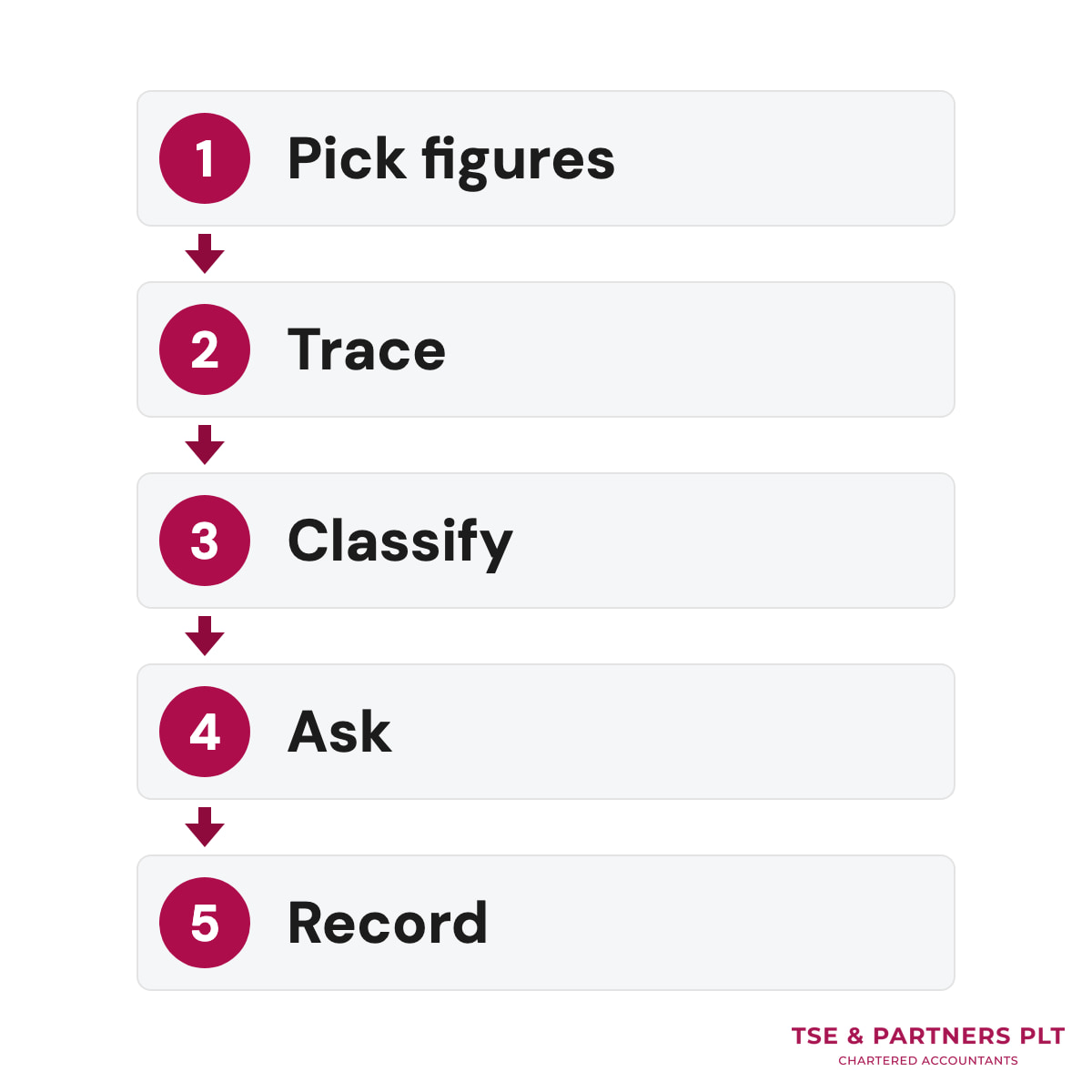
The method has 5 steps:
Pick figures. Choose the largest, the biggest changes from last year and any linked to events you know about, such as an asset sold or a customer in dispute. If you receive management accounts, compare the draft with your latest monthly figures.
Trace. Follow each figure from the main statement to its note, then to your own records. A monthly bookkeeping checklist keeps records tidy enough to make this quick.
Classify. Each result falls into one of three groups. It agrees. It is a mismatch: two figures that should agree do not, often through timing, a typing error or a missed entry. Or it needs a judgement: an assessment management makes with the preparer's advice, such as how much of an overdue customer balance is recoverable.
Ask. For each item you cannot settle yourself, send your preparer a written question, or query, naming the figure, the difference and your evidence.
Record. Note each answer and the draft version it applies to.
A worked example shows what these steps catch that a read-through would miss. The next three sections follow one hypothetical draft (v1) for a small trading company with a year ending 31 December 2026. Amounts are in RM.
Check the equipment figure against your asset register
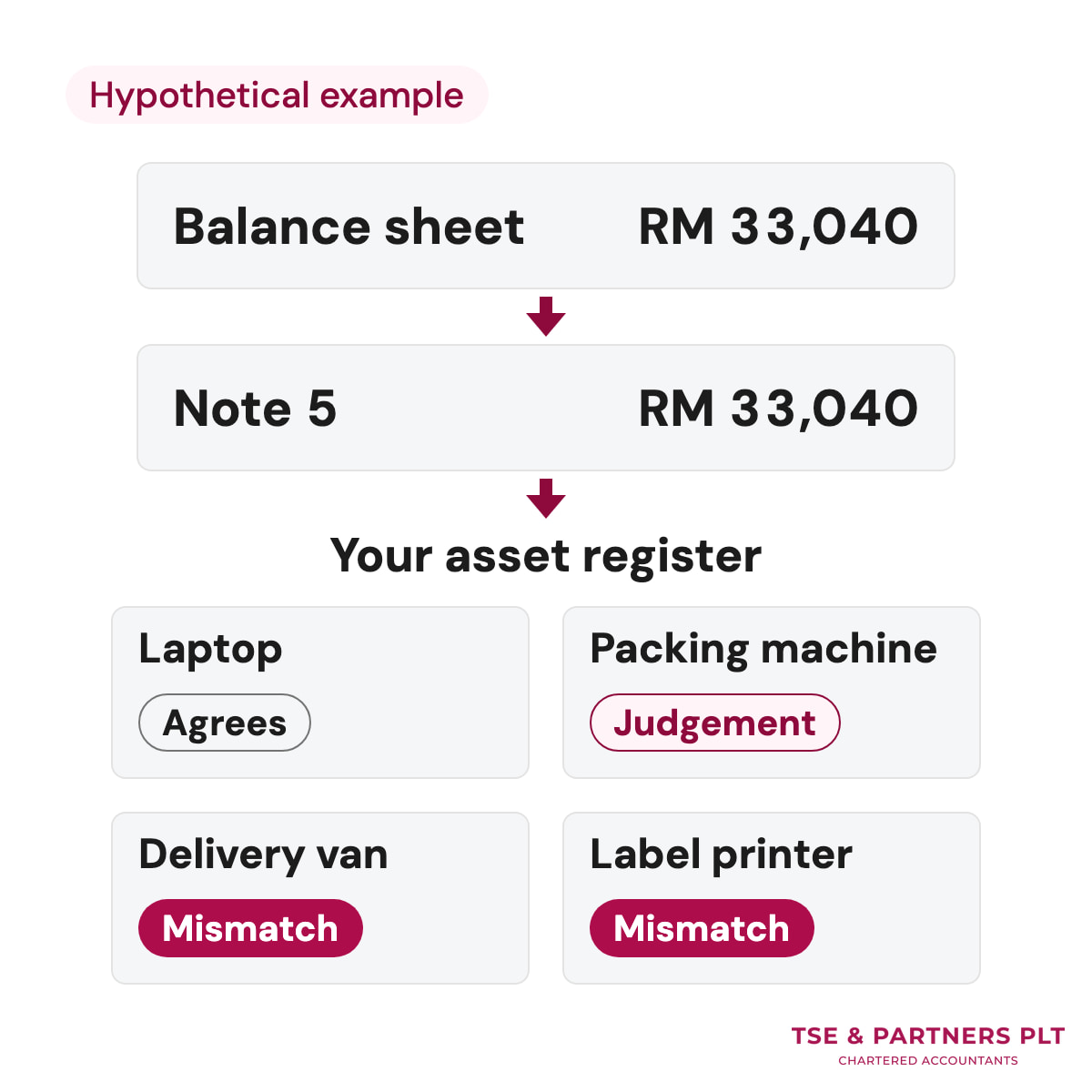
Start with equipment if the company has sold, scrapped or lost anything. The balance sheet shows property, plant and equipment, meaning equipment and vehicles, of 33,040. Note 5 gives their cost of 134,000, less depreciation charged so far of 100,960. Depreciation spreads an asset's cost over the years the company expects to use it. An asset's carrying amount, sometimes called net book value, is the amount at which it is recorded in the accounts. In this example, which has no impairment or revaluation, each item's carrying amount is its cost less depreciation so far. An impairment writes an asset down when the company expects to recover less from it than its recorded amount. A revaluation records an asset at an updated value instead of cost. The note gives totals, so compare each item in your fixed asset register with what you know.
| Item | Carrying amount (RM) | What you know and the result |
|---|---|---|
| Laptop | 0 | In daily use. Agrees. |
| Packing machine | 14,400 | Idle since September, due back in use in March. Judgement, facts sent. |
| Delivery van | 18,000 | Sold 14 November, RM 25,000 received 18 November. Mismatch, query sent. |
| Label printer | 640 | Missing since a 2025 branch closure, no sale or scrap record. Mismatch, query sent. |
| Total | 33,040 | Matches Note 5 |
Two points explain these results. First, an asset is removed from the accounts when it is disposed of, such as sold or scrapped, or when no future benefit is expected from using or selling it. A zero carrying amount alone is not a reason to remove it, so the laptop still being listed is not an error in itself. Second, the packing machine is idle. Whether that changes its depreciation or calls for a write-down depends on the facts, the depreciation method and your company's reporting framework, which is why it is a judgement. Tell your preparer the facts about the machine, including when it stopped and when it is due back in use. Ask your preparer to explain whether the facts call for an adjustment, and review the assessment and reasons.
Your company's reporting framework sets the detailed rules. Private companies use either MPERS, the Malaysian Private Entities Reporting Standard, or the Malaysian Financial Reporting Standards (MFRS), so ask your preparer which applies. For the example's year to 31 December 2026, MPERS means the 2016 edition unless the 2025 edition was adopted early. A Malaysian Institute of Accountants (MIA) technical article from August 2023, before MPERS 2025 was issued, describes the same removal rule for MPERS and says fully depreciated assets still in use stay in the records. Other areas, such as revenue, change between MPERS 2016 and MPERS 2025.
The van and the printer need queries. For the van, you might write: "The Note 5 total still includes the delivery van, which our register shows at RM 18,000. We sold it on 14 November. The sale agreement and bank receipt are attached. Please confirm how the sale is reflected." Ask your preparer to calculate and explain any profit or loss on the sale. For the printer, say plainly that you cannot find it and have no record, and ask what the preparer needs from you. The honest answer may stay "unknown". Record that too.
The 33,040 total matched Note 5 exactly, yet two of the four items behind it did not match what you know.
Check what customers owe for mismatches and judgements
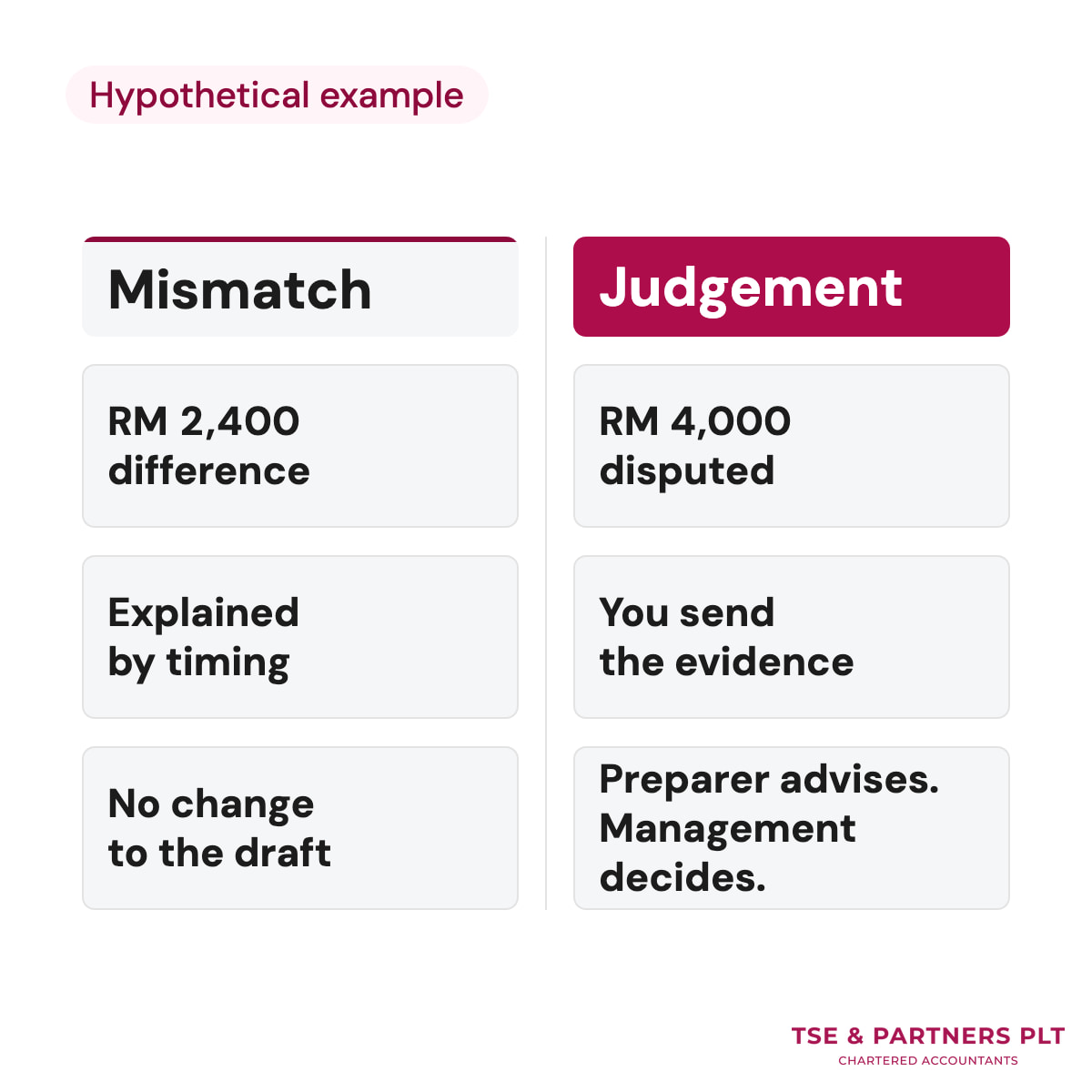
What customers owe shows both kinds of problem: a mismatch your preparer explains and you confirm, and a judgement management makes with the preparer's advice. The balance sheet and Note 7 show trade receivables, meaning what customers owe, of 84,500. Your aged receivables listing as at 31 December, run on 15 January 2027, shows 86,900, which is 2,400 more. The preparer explains that an invoice of 2,400 had been entered twice, and the duplicate was cancelled in the 2026 accounts on 22 January 2027, after you ran the listing. You confirm it really was a duplicate and run the listing again. It now shows 84,500, which matches. No figure in the draft changes.
Customer K is different. At the year-end, K owed 6,000, part of the 84,500, and the balance was 210 days overdue. K paid 2,000 on 20 January 2027 and disputes the remaining 4,000 in writing. Your listing cannot tell you whether K will pay the 4,000. Assess recoverability with your preparer's advice. Send them the receipt and dispute letters. Keep the item open until management's assessment, the accounting treatment and the reasons are recorded.
| What to compare | Mismatch (the listing difference) | Judgement (Customer K) |
|---|---|---|
| What you see | Listing 86,900, note 84,500 | RM 4,000 overdue and disputed |
| What resolves it | A document showing the timing difference | Management's assessment, supported by the preparer's advice |
| What you record | The explanation and the cancelled invoice reference | The evidence you sent, the decision and the reasons |
Check what the company owes, including bills after year-end
The balance sheet shows other payables of 32,200, made up of accruals and customer deposits. Accruals are costs that belong to the year but had no invoice by the year-end, such as utilities, professional fees or a staff bonus not yet paid. Customer deposits are money customers paid in advance for goods not yet delivered. Note 12 breaks the figure down, in v1 and in the corrected v2. Checking Note 12 against your own records turned up three separate issues.
| Line in Note 12 | v1 (RM) | v2 (RM) |
|---|---|---|
| Accruals: utilities | 2,100 | 2,100 |
| Accruals: professional fees | 7,500 | 6,500 |
| Accruals: staff bonus | 9,600 | 9,600 |
| Customer deposits | 14,000 | 14,000 |
| Note total | 33,200 | 32,200 |
A note total that differs from the balance sheet
In v1 the four lines in Note 12 add up to 33,200, but the balance sheet shows 32,200. The difference is 1,000. Your accruals list shows professional fees of 6,500, not 7,500, so the three accruals come to 18,200. The preparer confirms a typing error in the note. In v2 the note totals 32,200 and matches the balance sheet, which did not change.
A deposit list printed before the year-end
The note shows customer deposits of 14,000. Your deposit register shows 17,000: Customer A 6,000, Customer B 6,000 and Customer C 5,000. Then you notice the printout is dated 17 December. On 18 December, 3,000 of Customer C's deposit was used to pay part of an invoice, as the invoice and delivery note show. Printed again as at 31 December, the register shows C at 2,000 and a total of 14,000, which matches the note.
From the total alone, you cannot tell whether each deposit is recorded under the right customer. You have no remittance advice (the payer's note saying what a payment is for) covering Customer B's 6,000. So one query remains: "Please confirm which bank receipt the RM 6,000 deposit for Customer B was matched to, and who paid it."
A bill dated after the year-end
A contractor's bill dated 9 January 2027 for 4,200 covers an air-conditioning repair at your office, finished on 20 December 2026 according to the job sheet. You cannot find the 4,200 in Note 12. Raise it as a query, without working out the effect yourself: "The repair was done in December and billed in January. Is it reflected in the draft, and if so, where?" A bill dated after the year-end can still be evidence of work done before the year-end. Ask your preparer to explain the treatment and any adjustment needed.
Record what you checked and asked before you decide
List each item you checked and its status. At v2, the example company's record looks like this.
| Status at v2 | Items |
|---|---|
| Agrees with your records | Laptop, customer balances total, deposits total |
| Corrected in v2 | Note 12 total |
| Query open | Delivery van, label printer, Customer B deposit, repair bill |
| Judgement pending | Packing machine, Customer K's disputed RM 4,000. Facts sent, decision awaited. |
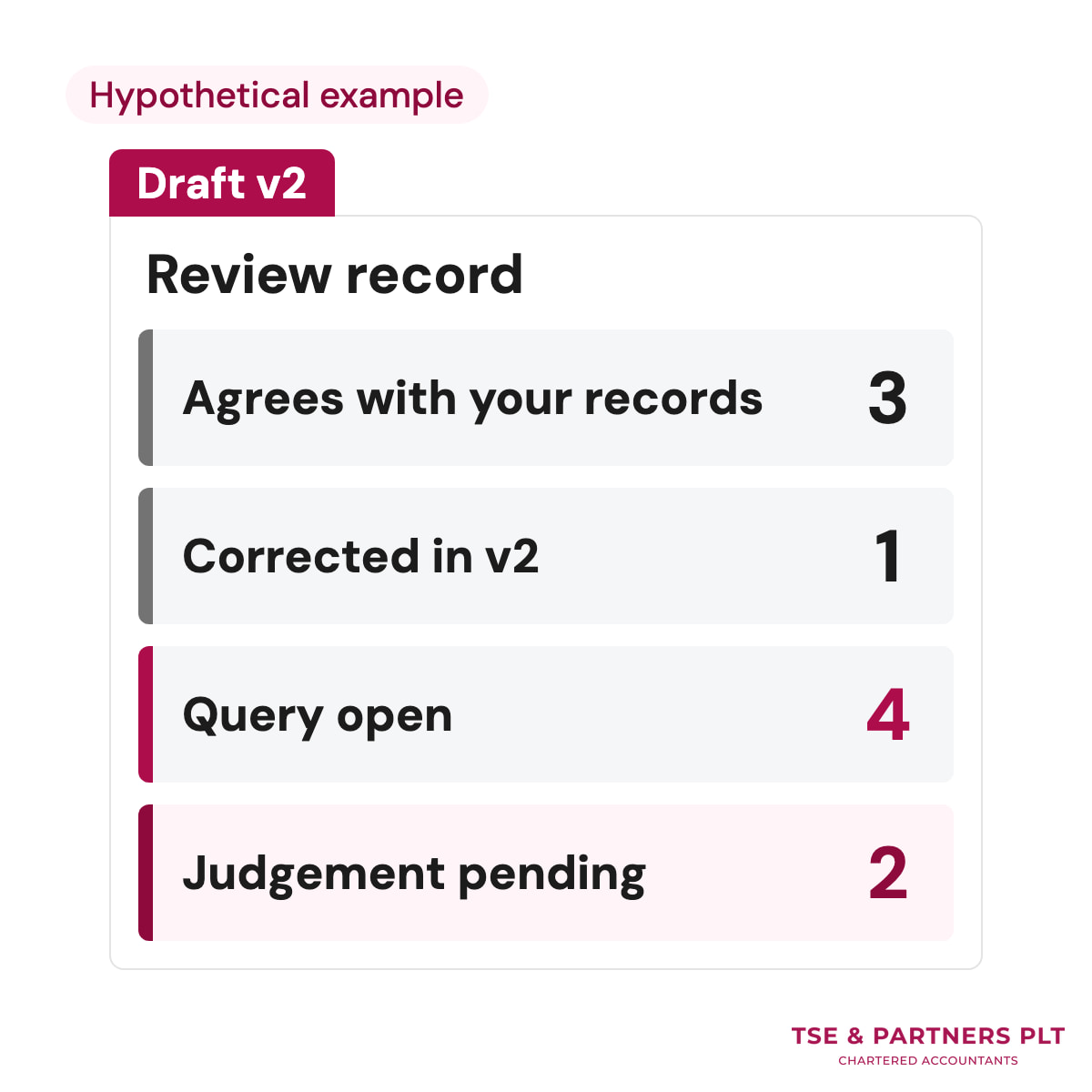
In the example, 6 of the 10 items are still open at v2. Before approving, make sure unresolved matters have been assessed and any necessary adjustments or disclosures made. Recording why an item remains open is not enough if the financial statements could still be materially wrong. Approving the statements remains the directors' decision. Your record shows what you checked, what you asked and what you were told.
TSE & Partners supports Malaysian SMEs, especially in Kuala Lumpur, with accounting and bookkeeping work delivered through associates. That includes preparing financial statements from the records you supply. This support does not include audit or assurance work. If you would like help with your year-end accounts, see our accounting and bookkeeping services in Kuala Lumpur or talk to TSE & Partners.
Questions directors ask before signing
Is there a checklist for reviewing draft financial statements?
Yes. Use the 5 steps above: pick figures, trace, classify, ask and record. Start with three or four large figures, such as equipment, customer balances and other payables.
Should I correct the figures myself?
Ask the preparer to make and explain adjustments in the working draft. Supply the evidence, review the treatment and retain responsibility for the statements you approve. If something is wrong, the preparer makes the adjustment and sends a revised draft with a new version label. Keep the earlier version so you can see what changed.
What if the preparer says an item is a judgement?
Give the preparer the facts you have, such as payments, letters or dates. Ask for the preparer's advice and record management's decision and reasons. Keep that answer with the draft version you approve, so you can show what the decision rested on.
Does checking the draft mean the statements are audited?
No. Tracing figures is your own check as a director. It is not an audit, and it does not give an independent opinion on the statements.
Data Sources and References
Companies Commission of Malaysia (SSM), Companies Act 2016, updated as at 31 January 2025, sections 244(2), 248(1) and 251(1)–(3), on directors' responsibility for preparing and approving financial statements.
International Auditing and Assurance Standards Board, ISRS 4410 (Revised), Compilation Engagements, paragraphs 7, 22, 24(e), 30, 37 and A51, on management's responsibility and the practitioner's assistance with judgements. This reference does not describe TSE's service as an ISRS 4410 compilation engagement.
Malaysian Accounting Standards Board, Approved Accounting Standards for Private Entities. Private entities apply either MPERS or MFRS in full. MPERS (2025) applies to annual periods beginning on or after 1 January 2027, with earlier application permitted.
Malaysian Accounting Standards Board, Malaysian Private Entities Reporting Standard (2016).
Malaysian Institute of Accountants, MFRS and MPERS Common Issues on Investment Property and Property, Plant and Equipment, 17 August 2023, by the MIA technical team. Covers MPERS paragraph 17.27 and fully depreciated assets still in use. It predates MPERS (2025), and MIA states its views are not its official opinion.
Malaysian Institute of Certified Public Accountants, The Malaysian Accountant, September to October 2025, TechWatch "MASB Update", printed pages 29 to 30. A journal report that MPERS (2025) is based on the third edition of the IFRS for SMEs Accounting Standard and applies to annual periods beginning on or after 1 January 2027, with early application permitted. It is not the text of the Standard.
IFRS Foundation, IFRS for SMEs supporting material, Module 17 Property, Plant and Equipment (third edition), paragraphs 17.15 to 17.15B, 17.20 and 17.27. International educational material on the IFRS for SMEs Accounting Standard, not the text of MPERS.
IFRS Foundation, IFRS for SMEs supporting material, Module 17 Property, Plant and Equipment (2015 edition), paragraphs 17.15 to 17.15B, 17.20 and 17.27. International educational material on the IFRS for SMEs Accounting Standard, not the text of MPERS.
IFRS Foundation, IFRS for SMEs supporting material, Module 32 Events after the End of the Reporting Period (2015 edition).
The information in this article is general guidance only. It does not constitute accounting, tax, financial or legal advice and may not fit your circumstances. Confirm the engagement scope and seek qualified advice before acting.