Key Takeaways
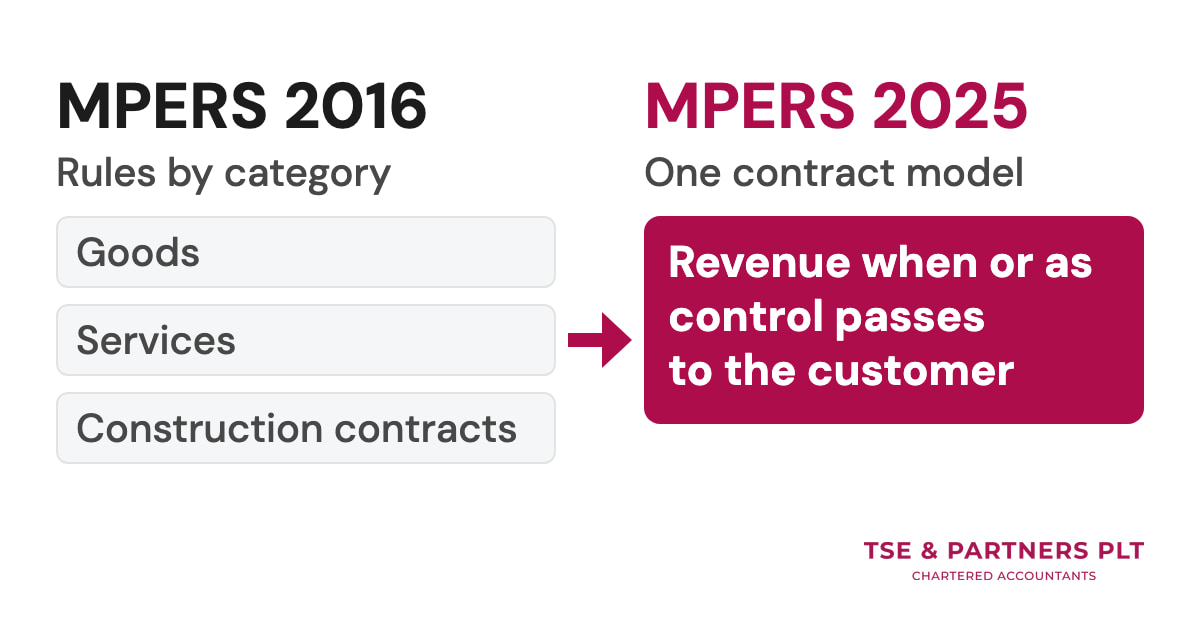
- MPERS 2025 replaces separate revenue rules for goods, services and construction contracts with one model based on when control of what you sell passes to the customer.
- It applies to financial years beginning on or after 1 January 2027, so a 31 March or 30 June 2027 year-end stays on MPERS 2016 unless applied early.
- For made-to-order work, what the customer must pay if it cancels can decide whether revenue is recognised as the work progresses.
- Splitting a product-and-service price is not new, and ordinary delivery sales may well not change. Where a customer can still earn a rebate, part of the revenue may be held back, meaning not yet recorded.
For revenue, the move from MPERS 2016 to MPERS 2025 changes the rules for when a sale is recognised, meaning recorded as revenue. MPERS is the Malaysian Private Entities Reporting Standard. Its revenue section, renamed Revenue from Contracts with Customers, moves from separate rules for each category of sale to one model for contracts with customers.
Ordinary sales may not change. Made-to-order work, products sold with a service and rebates may, and the terms of those contracts largely decide the effect. Revenue is one of six sections listed as significantly changed in the Malaysian Accounting Standards Board (MASB) update, and the only one covered here. Whoever handles your financial statement preparation will need those contracts before your first MPERS 2025 year-end.
For the wider year-end picture, see how to read financial statements and what to do when a stock count takes place after year end.
What changes for revenue between MPERS 2016 and MPERS 2025?
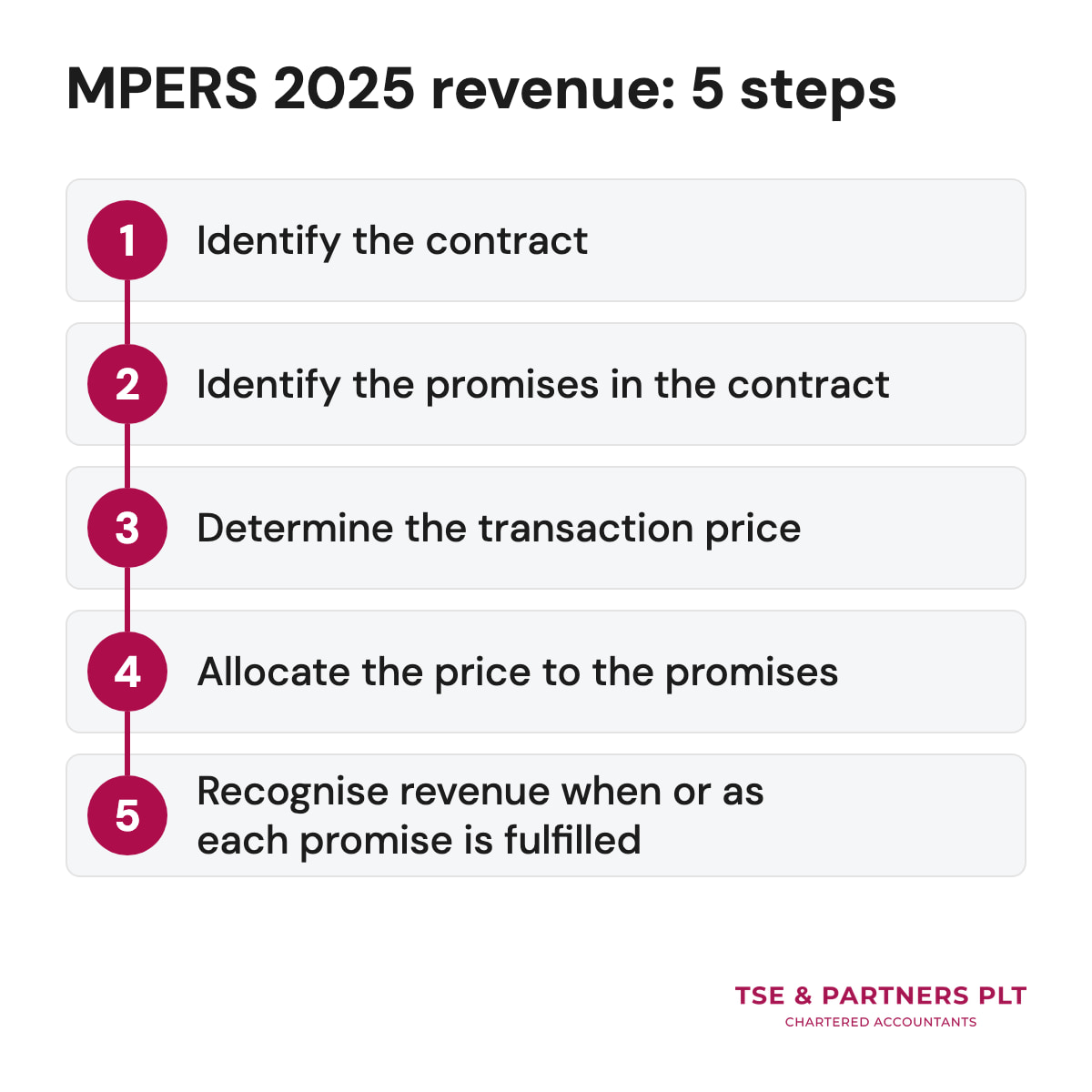
MPERS 2016 had rules by category. Sales of goods were recognised when significant risks and rewards of ownership passed to the buyer and other conditions were met. Services and construction contracts were recognised in line with work done (stage of completion) if the outcome could be estimated reliably. MPERS 2025 uses one five-step model. Revenue is recognised when, or as, control of each promised good or service passes to the customer.
MPERS is based on the IFRS for SMEs Accounting Standard, an international standard for smaller companies. MPERS 2016 adopted it almost word for word, and MPERS 2025 is based on its 2025 edition.
The 5 steps in paragraph 23.3 of the IFRS for SMEs Accounting Standard (2025) are:
Identify the contract.
Identify the promises in the contract.
Determine the transaction price.
Allocate the price to the promises.
Recognise revenue when, or as, each promise is fulfilled.
A promise is an obligation to transfer a distinct good or service. Distinct means the customer can benefit from it on its own or with things readily available to it, and it is separate from your other commitments in the contract (paragraph 23.18). MFRS 15, the revenue standard in the fuller Malaysian Financial Reporting Standards (MFRS), calls these performance obligations.
Control means the customer can decide how the item is used and obtain its benefits (paragraph 23.50). This is control of what you sell, not of a company. The customer having the risks and rewards of ownership, such as bearing any loss if the item is damaged, is still one of the listed signs that control has passed (paragraph 23.58).
When MPERS 2025 starts for your financial year
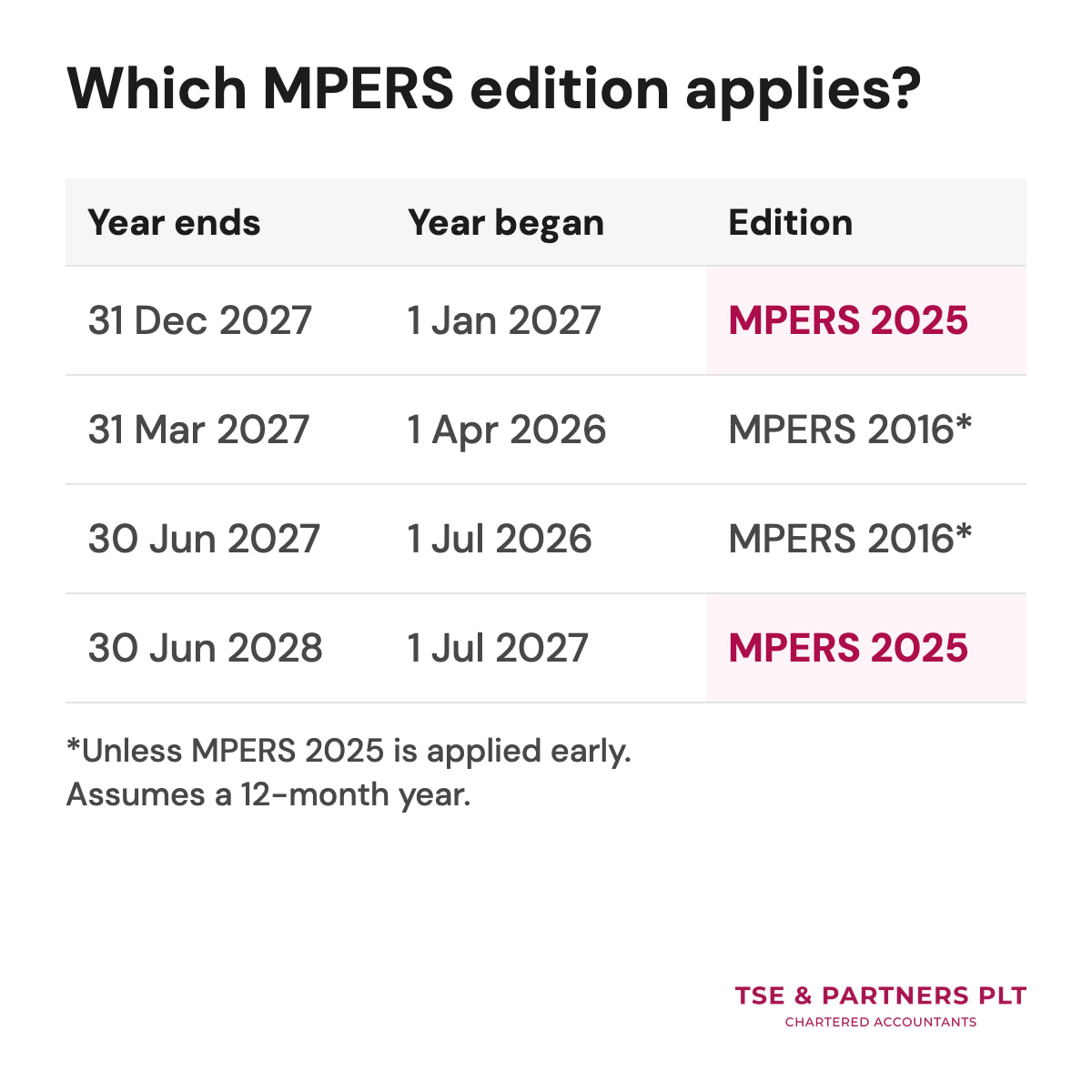
MPERS 2025 takes effect for financial years beginning on or after 1 January 2027, with early application permitted, according to the MASB update reported by the Malaysian Institute of Certified Public Accountants (MICPA). What counts is when your year begins, not when it ends.
| Financial year ends | Year began | Edition that applies |
|---|---|---|
| 31 December 2027 | 1 January 2027 | MPERS 2025 |
| 31 March 2027 | 1 April 2026 | MPERS 2016, unless applied early |
| 30 June 2027 | 1 July 2026 | MPERS 2016, unless applied early |
| 30 June 2028 | 1 July 2027 | MPERS 2025 |
The table assumes a 12-month financial year. Companies using MFRS instead are not covered here. Ask your preparer, meaning whoever prepares your financial statements, how contracts still running at the switch will be handled.
5 contract features to check against both editions
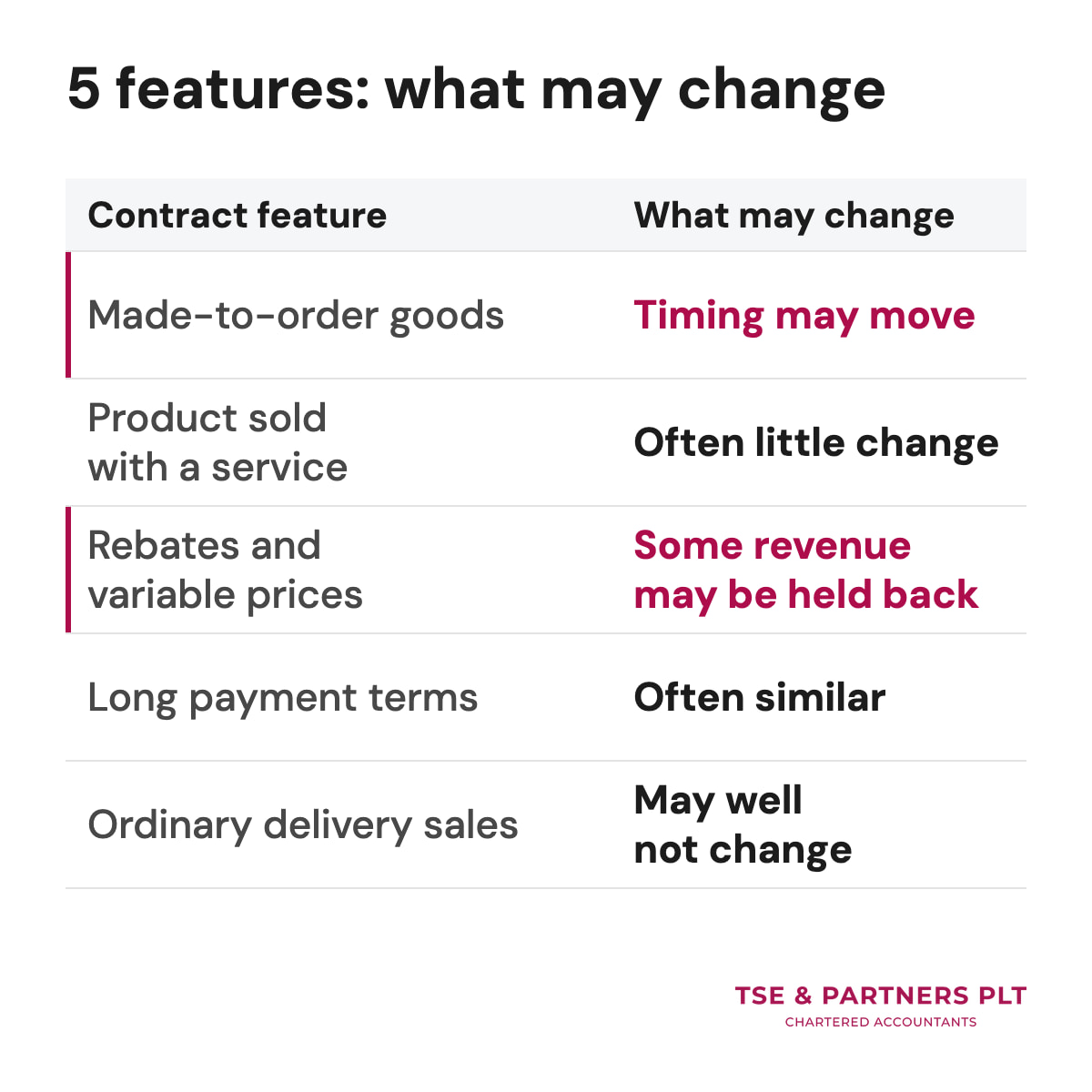
The table compares five contract features so you can see which of your sales could be affected. The next two sections work through the first three with examples.
| Contract feature | MPERS 2016 (IFRS for SMEs 2015) | MPERS 2025 (IFRS for SMEs 2025) | What may change |
|---|---|---|---|
| Made-to-order goods | A sale of goods when risks and rewards pass and other conditions are met, or a construction contract by stage of completion if its outcome can be estimated reliably | Over time, as the work progresses, if an over-time test is met, such as an item hard to sell to anyone else plus a right to payment for work done to date. Otherwise when control passes | Timing may move, often depending on what the customer pays if it cancels |
| Product sold with a service | Price split into separately identifiable parts, such as later servicing | Price split between distinct promises by stand-alone selling prices | Often little, if you already split the price |
| Rebates and variable prices | Discounts and volume rebates taken into account | Estimate, then include only revenue it is highly probable you will be entitled to | Some revenue may be held back |
| Long payment terms | Discounted if in effect a financing transaction | Discounted if a financing transaction, with interest shown separately. Adjustment optional if payment is expected within a year of supply | Often similar |
| Ordinary delivery sale | When risks and rewards pass and other conditions are met | When control passes, using signs such as legal title and possession | May well not change |
A stand-alone selling price is what you charge for an item sold on its own. A financing transaction is a sale where unusually long credit means part of the price is in effect interest. Discounted here means that interest part is taken out of the sale price.
Made-to-order work and the cancellation payment clause
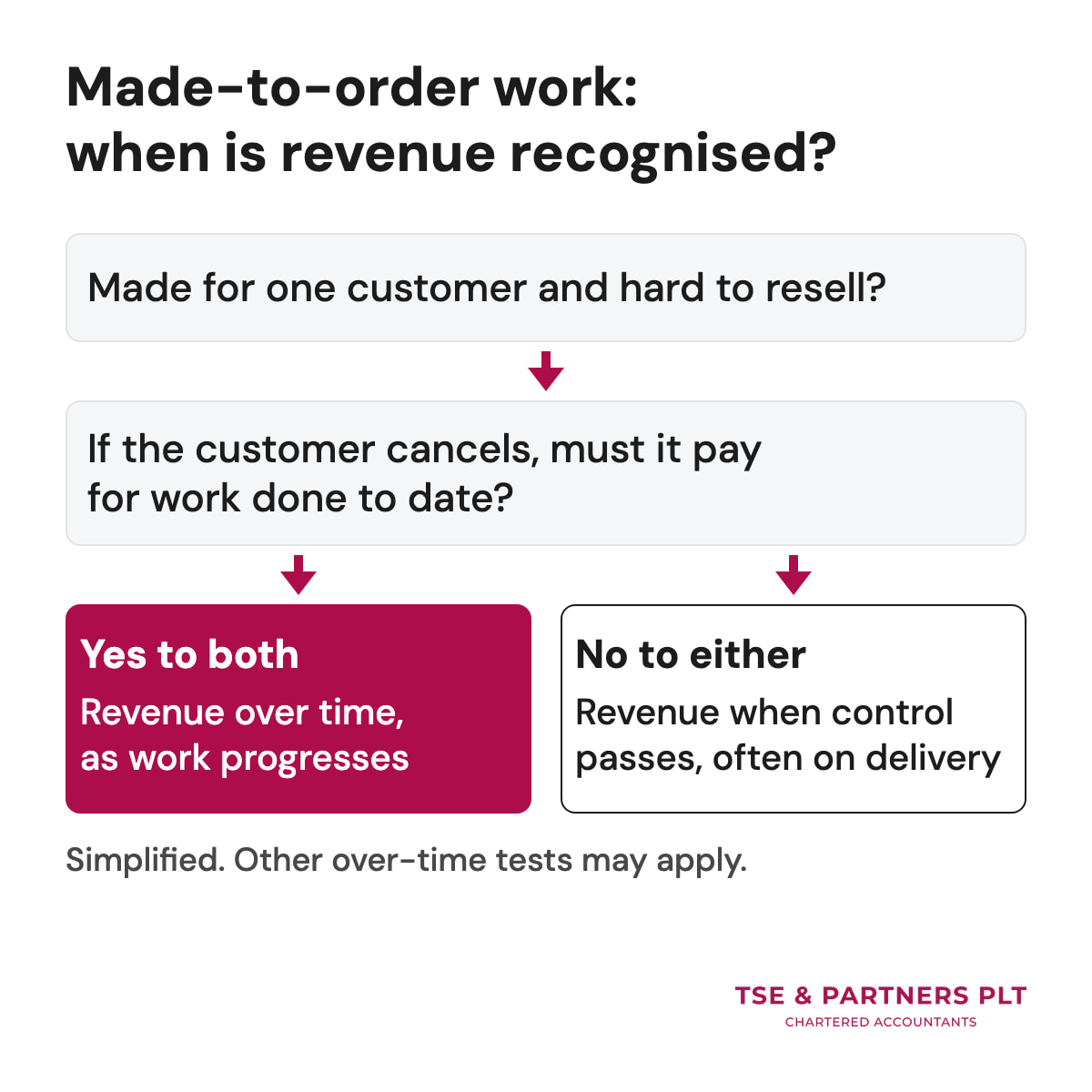
Under MPERS 2016, a customised order was first treated as either a sale of goods or a construction contract, measured by stage of completion if its outcome could be estimated reliably. That depended on the facts, so the example below gives no 2016 figure. Under MPERS 2025, the question is whether control passes over time, as the item is made. If it does, revenue is recognised as the work progresses.
Paragraph 23.54 gives 3 situations where this happens, including when the customer controls the item as it is built. The one that most often depends on contract wording is paragraph 23.54(c), which needs both of these:
The item cannot easily be sold to another customer without a significant price cut or rework (paragraph 23.55).
You have a right to be paid for the work done to date (paragraph 23.56). That means either an unconditional right to payment for it now, or an enforceable right to demand or keep payment for it if the customer cancels for any reason other than your own failure to perform. The right can come from the contract or from the law that applies to it.
To see what a cancellation payment clause changes, take a hypothetical maker in its first MPERS 2025 year. With the clause, it records part of the contract price as revenue that year, as the work is done. Without it, it may record nothing until delivery the next year.
The maker, a Sdn Bhd, has a financial year from 1 January to 31 December 2027. On 1 November 2027 it signs a RM80,000 contract to make and install display cabinets to one retailer's layout, due in February 2028. The cabinets cannot be resold without significant rework. The contract says that if the retailer cancels other than for the maker's failure, it must pay for work done to date at cost plus a margin. Assume this clause is enforceable. Expected costs are RM60,000, with RM24,000 incurred by 31 December 2027. The maker judges that costs incurred fairly show progress, so progress is measured by costs (an input method, paragraph 23.65). Costs incurred include work done by 31 December even if the supplier's invoice arrives later. See invoices after year end for which year such bills belong to.
Progress is RM24,000 ÷ RM60,000 = 40%, so revenue for 2027 is 40% × RM80,000 = RM32,000. The remaining RM48,000 is recognised in 2028.
If cancellation leaves the maker only payments received
Now suppose that if the retailer cancels, the contract only lets the maker keep progress payments already received. Nothing in the contract or the law that applies to it gives the maker a right to be paid for work done to date. So paragraph 23.54(c) is not met, as in an IFRS Foundation training example. If no other over-time situation applies, revenue is recognised when control passes, likely on delivery and installation in 2028. Revenue from this contract in 2027 is then RM0.
For this maker, the clause decides whether 2027 revenue from the contract is RM32,000 or nothing. So check what your own made-to-order contracts say a cancelling customer must pay. Whether that clause can be enforced is a legal question outside this article. Your preparer will ask how it was assessed, and whether another over-time situation applies, before advising on the revenue treatment.
Bundled prices and rebates: what is new and what is not
A product sold with a service
Splitting a bundled price is not new. Under the 2015 edition, an identifiable amount for later servicing was already separated from the sale price (paragraph 23.8). The 2025 edition spells out when a service is a separate promise and how to split the price by stand-alone selling prices, estimated if you do not sell the item alone (paragraphs 23.18, 23.42 and 23.44).
A machine sold with maintenance shows how the split works, and why the result may be close to what the 2015 edition gave. In 2027 a hypothetical company with a 1 January to 31 December financial year sells a machine with 2 years' maintenance for one price of RM60,000. The machine is delivered on 1 October 2027 and maintenance runs to 30 September 2029. The stand-alone selling prices are RM56,000 for the machine and RM8,000 for the maintenance, RM64,000 in total.
Machine: RM60,000 × 56,000 ÷ 64,000 = RM52,500, recognised when control passes on delivery.
Maintenance: RM60,000 × 8,000 ÷ 64,000 = RM7,500, or RM312.50 a month over 24 months, assuming the service is provided evenly.
Revenue for 2027 is RM52,500 plus 3 months of maintenance (RM937.50), or RM53,437.50. The remaining RM6,562.50 is recognised over the next 21 months. The IFRS Foundation's 2015 training material already split bundled prices this way, so results may be similar. Keep the separate price lists behind this split.
Rebates and other variable prices
Rebates were already taken into account under the 2015 edition (paragraph 23.3). The 2025 edition adds 2 explicit stages. First, estimate the price allowing for the rebate, using a probability-weighted amount or the most likely amount (paragraph 23.28). Then include only the part it is highly probable the business will become entitled to (paragraph 23.30). Any amount above that is held back, meaning not yet recognised as revenue.
MFRS 15 also uses "highly probable", but asks whether recognised revenue could later be significantly reversed. The IFRS for SMEs test asks about entitlement.
This hypothetical case shows how much revenue is held back when a customer's rebate year runs past the supplier's 31 December year-end. A customer pays RM100 a unit and earns a 5% rebate on all units if it buys 2,000 or more between 1 July 2027 and 30 June 2028. By 31 December 2027 it has bought 1,200 units. Assume the supplier's evidence, such as the customer's orders so far and its volumes in earlier rebate years, shows the customer is likely to reach 2,000 units. On that evidence, it is not highly probable that the supplier will become entitled to the full RM100 a unit. Its entitlement to RM95 a unit is certain.
Revenue for 2027: 1,200 × RM95 = RM114,000.
Held back: 1,200 × RM5 = RM6,000.
That RM6,000 stays out of 2027 revenue for as long as the evidence does not make the supplier's entitlement to it highly probable. It is recognised only if entitlement becomes highly probable, for example if the customer finishes its rebate year below 2,000 units. Your preparer needs each customer's year-to-date volumes to work this out.
What to prepare before your first MPERS 2025 year-end
If your sales are ordinary deliveries on normal terms, expect little change, but confirm with your preparer. Otherwise, list the contracts that have any of the features in the table above, and gather:
signed contracts and change orders for made-to-order work, including the cancellation and payment clauses
rebate and incentive schemes, with the year-to-date volumes behind them
separate price lists for items you also sell as a bundle
any terms that give customers more than a year to pay
When the first MPERS 2025 draft statements arrive, ask your preparer how revenue on these contracts was treated. See what to check before signing financial statements for the wider review. Our monthly bookkeeping checklist helps keep sales invoices, credit notes and customer balances current.
TSE & Partners PLT, through its associates, prepares financial statements from the records you supply, under the reporting framework that applies to your company. This preparation is not an audit. For support with your records, see our accounting and bookkeeping services in Kuala Lumpur or speak to TSE & Partners.
Common questions about MPERS 2016 vs MPERS 2025 revenue
Will MPERS 2025 reduce my company's profit?
Not automatically. Revenue on made-to-order work that is hard to resell, where you have an enforceable right to be paid for work done to date if the customer cancels, is recognised as the work progresses. Part of the revenue on rebate sales may be held back. Ordinary sales may well not change. Your contract terms decide the effect.
My year ends on 31 March 2027. Does MPERS 2025 apply?
No, unless your company applies it early. That year began on 1 April 2026. Assuming 12-month years, your first MPERS 2025 year begins on 1 April 2027.
Is MPERS 2025 revenue the same as MFRS 15?
No. MFRS 15 is in substance the international IFRS 15. The IFRS Foundation says the IFRS for SMEs revenue section shares its principles but is simpler and less detailed, and some wording differs, such as the entitlement test for rebates.
Does this article cover property developers?
This guide does not cover property development contracts. Different requirements can apply depending on the reporting period and the framework your company uses. Ask your preparer which guidance applies to each year.
Data Sources and References
MPERS 2016 first took effect for annual periods beginning on or after 1 January 2016. MPERS 2025 is based on the 2025 edition of IFRS for SMEs, according to the MASB update reported by MICPA.
Official and professional sources
IFRS Foundation. IFRS for SMEs Accounting Standard, third edition (2025), Section 23 Revenue from Contracts with Customers. Paragraphs 23.3, 23.14, 23.18, 23.28, 23.30, 23.36 to 23.38, 23.42, 23.44, 23.50, 23.54 to 23.58 and 23.65.
IFRS Foundation. Educational Module 23, Revenue from Contracts with Customers (2025). Educational material, not part of the Standard. Used for the comparison with IFRS 15, the right-to-payment examples and the reproduced Section 23 text.
IFRS Foundation. Module 23, Revenue, IFRS for SMEs Standard (2015). Includes the full text of Section 23 as issued in October 2015 and states that the section was unchanged by the 2015 amendments. Paragraphs 23.3, 23.5, 23.8, 23.10, 23.14 and 23.17, and the pro-rata servicing example.
IFRS Foundation. Use of IFRS Standards by jurisdiction: Malaysia (profile last updated 20 March 2019. Historical background on MPERS (2016), including its separate property development requirements, and MFRS 15 only, not current eligibility).
Malaysian Institute of Certified Public Accountants. The Malaysian Accountant, September to October 2025, TechWatch "MASB Update". MPERS (2025) basis, the six sections with significant changes, and the effective date.
KTP & Company PLT. An Overview of MPERS 2025 (20 October 2026). A Malaysian practitioner analysis, not the Standard. Used only for its report that MPERS (2025) removes the separate property development guidance.
The information in this article is general guidance only. It does not constitute accounting, tax, financial or legal advice and may not fit your circumstances. Confirm the engagement scope and seek qualified advice before acting.