Key Takeaways
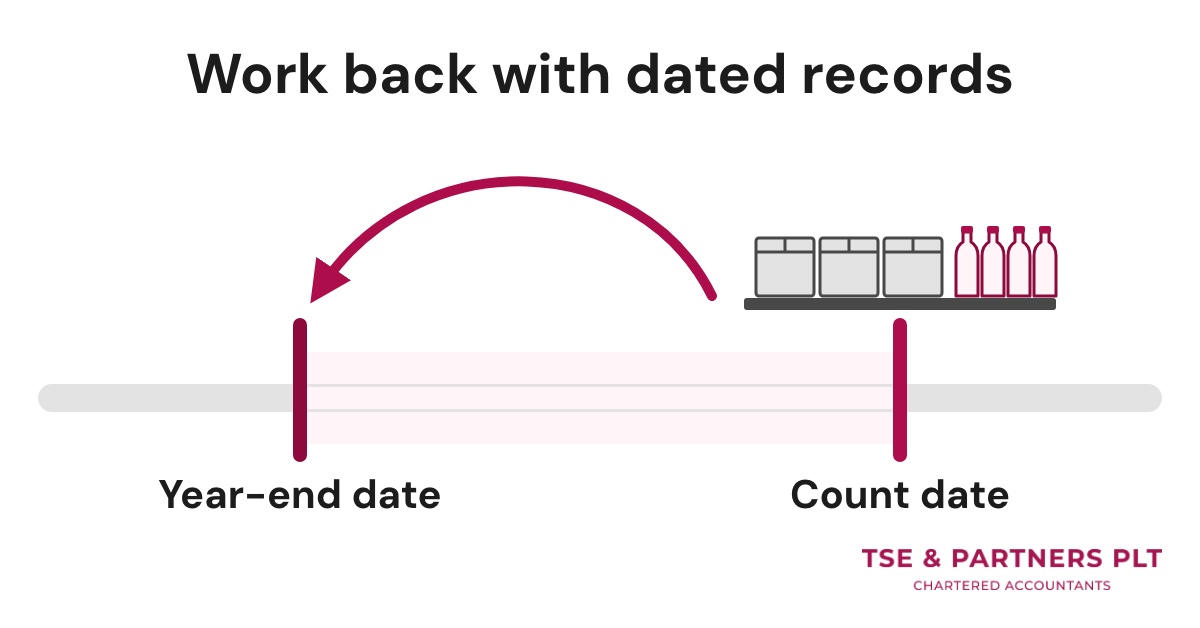
- A later stock count can often be worked back to the year-end date, using dated records of what came in and went out.
- Set the exact time of both cut-offs, then match the item, location and unit.
- Take away goods that arrived and add back goods that left between the two cut-offs.
- Keep any movement you cannot confirm out of the figure, as an open question for your preparer.
Your stock count took place a few days after your financial year ended. Your preparer (the accountant who puts your financial statements together) needs the quantity you held on the year-end date. You can often work the later count back to that date, using dated records of what came in or went out in between.
Your preparer uses that quantity in financial statement preparation, so they need to be able to check how you reached it. This guide covers quantities only, not what the stock is worth, tax or audit. If your year end has not arrived yet, counting at close of business on that day avoids this work.
For the wider year-end picture, see how to read financial statements and what MPERS 2025 changes for revenue.
Can you use a stock count taken after year end?
Often, yes. Start from the units you counted. Take away stock that arrived between the year-end date and the count, and add back stock that left in that gap. Each movement needs a dated record. Anything you cannot confirm stays out, as an open question for your preparer. A longer gap is harder to support.
The year-end date matters because the balance sheet shows the company's stock and other assets as at the last day of its financial year. A long gap with thin records may not be supportable at all.
Line up the two dates before you add or subtract
Working back links 2 cut-offs, the exact times your figures relate to: the year end, such as close of business on 31 December, and the count, such as close of business on the count day. Only movements between them go into the working. A delivery on the afternoon of 31 December, before close of business, was already in the store at year end, so it stays out. So does anything that moved after the count.
Then check that the count and each record match on:
Item: the same item code or description.
Location: the same shop, store or warehouse.
Unit: the same unit, converting cartons to bottles where needed.
A usable count sheet shows the date, time and location of the count, each item with its quantity and unit, and the counter's signature. If you keep stock in more than one place, work back each location on its own, and record both ends of any transfer between them.
Find the records that show stock coming in and out
Each movement in the gap needs a record showing its date, item, quantity and unit. A second document that agrees makes it easier to rely on. The table shows the main record for each direction and what to check it against.
| Movement | Record to find | Document that should agree |
|---|---|---|
| Goods received from a supplier | Goods received note: your own dated note of what arrived | The supplier's delivery order for the same goods |
| Goods sent out to a customer | Delivery order: the note that goes with the goods, signed by the customer | The matching line in your dispatch log |
When you work back, take away goods that arrived between the two cut-offs, because they were not yet in the store at year end. Add back goods that left in that gap, because they were still there. This tracks where goods physically were. Ownership is for your preparer, covered below.
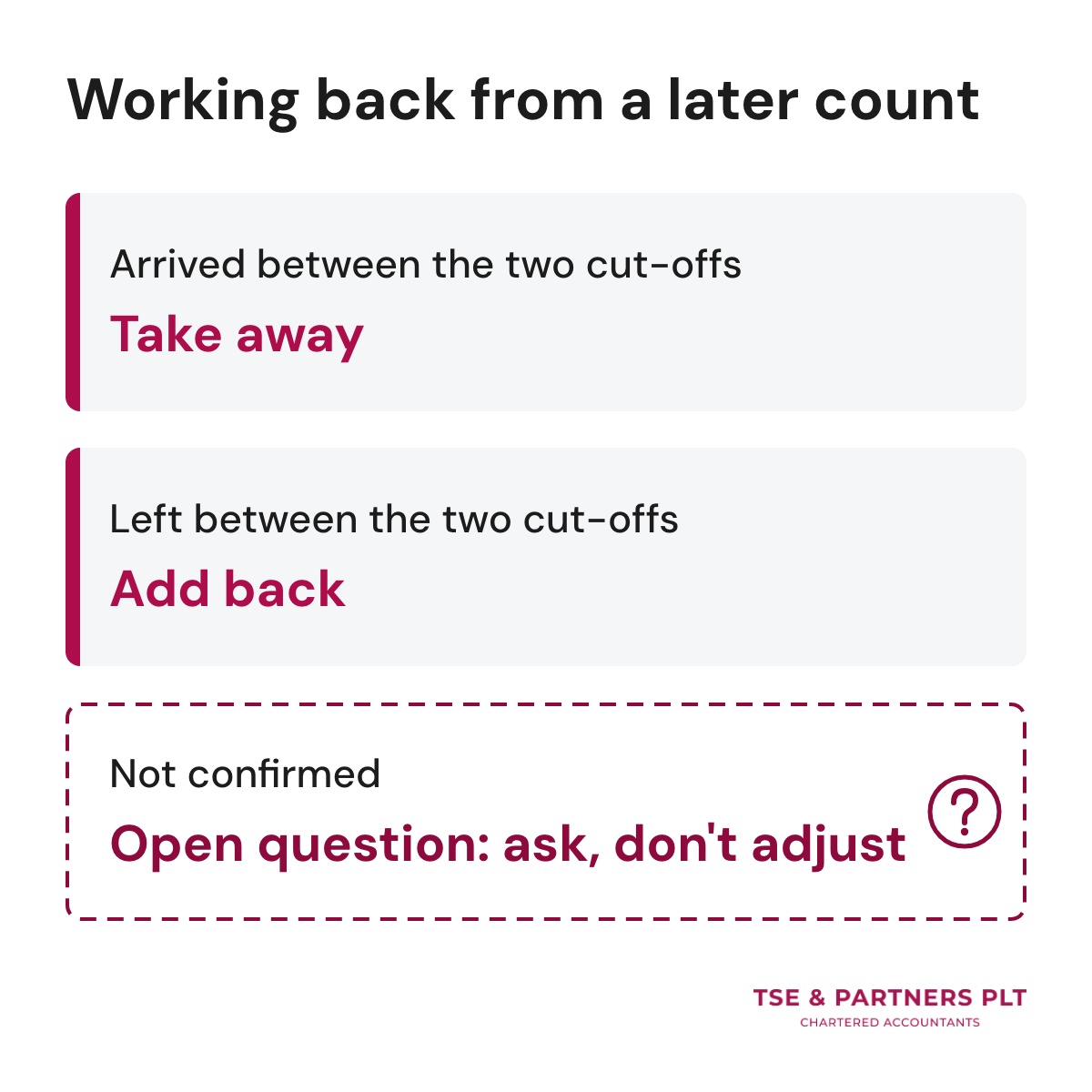
Stock thrown away in the gap also left. Add it back only if a dated, approved disposal note shows it went. A write-off in your books does not by itself show that goods left the store.
A customer return that came back in the gap is also an arrival. If a dated return note confirms it, take it away on its own line, whether or not the goods are still in your count. If returned goods then left again before the count, such as damaged items thrown away, that is a second movement. Add it back on its own line only if a dated record, such as an approved disposal note, shows the goods went. If either date is unclear, list it as an open question. Whether the goods were yours at year end, and any effect on the year-end figures, is for your preparer.
Use the date the goods physically moved. A supplier invoice dated after year end can cover goods that arrived before the gap began. Which year that bill belongs to is a separate question, covered in our guide to invoices after year end.
What was in stock at year end? A 6-day example
A late count often leaves a few delivery papers in a folder, one of them unclear. This example turns them into a figure your preparer can reproduce, without guessing the unclear part.
Consider an illustrative small trading company whose financial year ends on Thursday 31 December 2026. Nobody counted that day. Staff counted the main store at close of business on Wednesday 6 January 2027, and the signed count sheet shows 128 one-litre bottles of floor cleaner. Apart from the 3 records below, the receiving log and dispatch log show no movement of this item between the two cut-offs.
The table lists each record found for the gap and its effect when working back.
| Record | Date | What it shows | Supporting document | Effect when working back |
|---|---|---|---|---|
| GRN-01 (goods received note) | Monday 4 January 2027 | 2 cartons received, 10 bottles each | Supplier's delivery order for 2 cartons | Take away 20 bottles |
| DO-02 (delivery order) | Tuesday 5 January 2027 | 12 bottles delivered to a customer | Customer's signature and a dispatch log line | Add back 12 bottles |
| DO-03 (draft delivery order) | No date | 6 more bottles to the same customer | None: unsigned, not in the dispatch log | None yet: open question |
GRN-01 is in cartons but the count is in bottles, so convert first: 2 cartons of 10 is 20 bottles.
Using the 2 confirmed records, 128 − 20 + 12 = 120 bottles. That is a provisional year-end quantity.
DO-03 is why it stays provisional. If DO-03 is confirmed as a separate dispatch of 6 more bottles, not part of the 12 on DO-02, and those bottles left the store between the two cut-offs, the working gives 128 − 20 + 12 + 6 = 126. If DO-03 was an early draft of DO-02, the bottles never left, or they left outside the gap, the figure stays at 120. Adding the 6 now would mean guessing which is true. So the owner asks the staff member who handles dispatch:
Did the 6 bottles on draft DO-03 leave the store? If so, on what date? Is there a signed delivery order or a dispatch log line? Were they part of the 12 on DO-02?
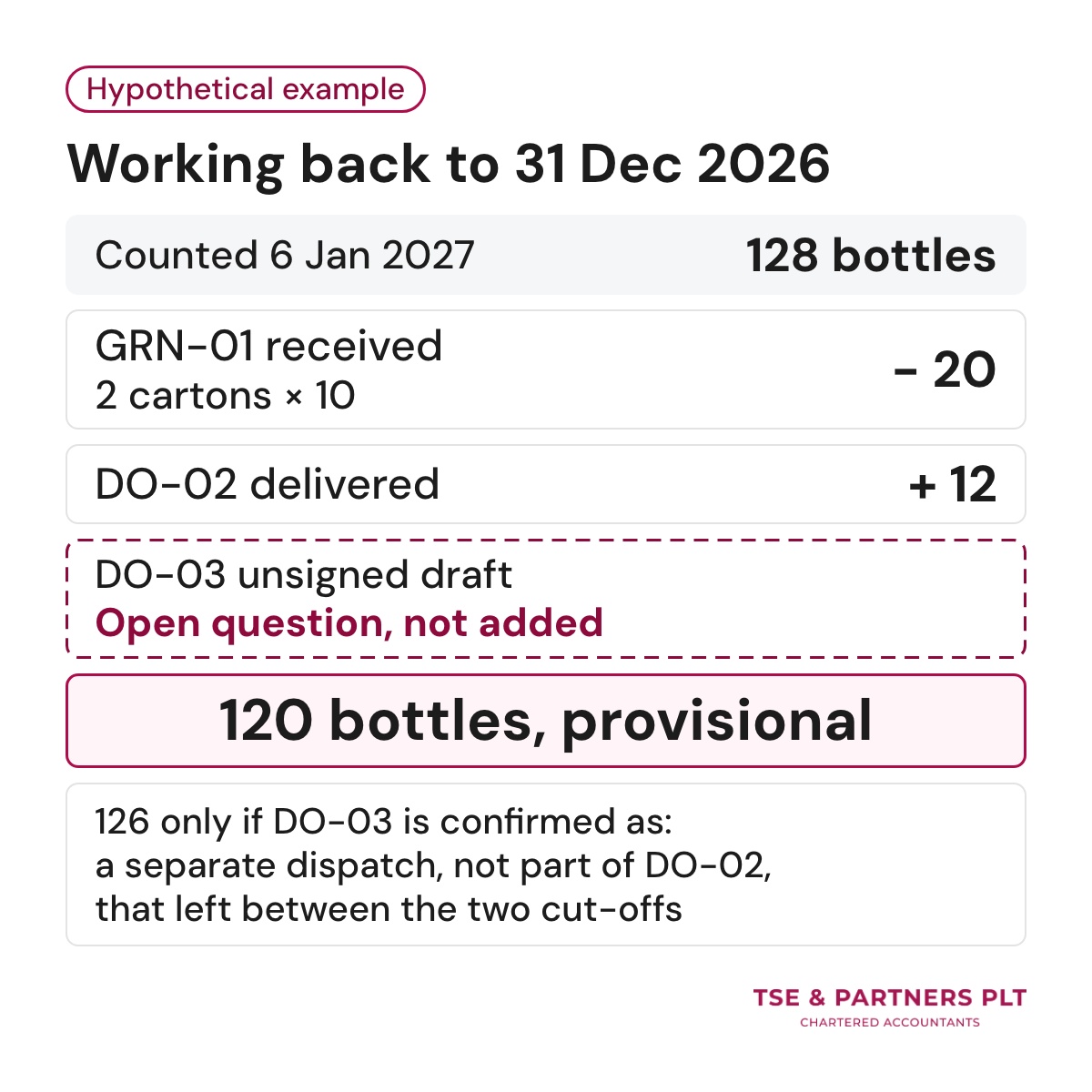
The owner sends 120 bottles as provisional, DO-03 as an open question, and a note that no other movements were found. The preparer assesses ownership and value and advises on any adjustment. Management remains responsible for the judgements and the final figures.
Now check your own folder for your version of DO-03: a paper suggesting stock moved, with no signature, date or log line. Each one goes on your list of open questions, not into the figure.
When working back cannot settle the figure alone
Your working still follows physical movements. Flag these for your preparer to assess their effect on the figures:
A long gap, high volumes, or missing or unsigned records. Say which item, location and dates are affected.
Goods in transit at either cut-off, such as goods that left your supplier before year end and reached you after it. Whether they were yours at year end depends on the facts and terms of sale.
Other people's goods in your store, such as customer goods awaiting collection, or consignment stock you hold to sell for a supplier who still owns it. They can be in your count without being your stock.
Damaged or expired stock found at the count. Say which items and how many. Your preparer assesses the facts and advises on the accounting treatment. Management remains responsible for the financial statements.
Do not change the stock figure in your accounting software to match your working.
What to send your preparer, and where TSE can help
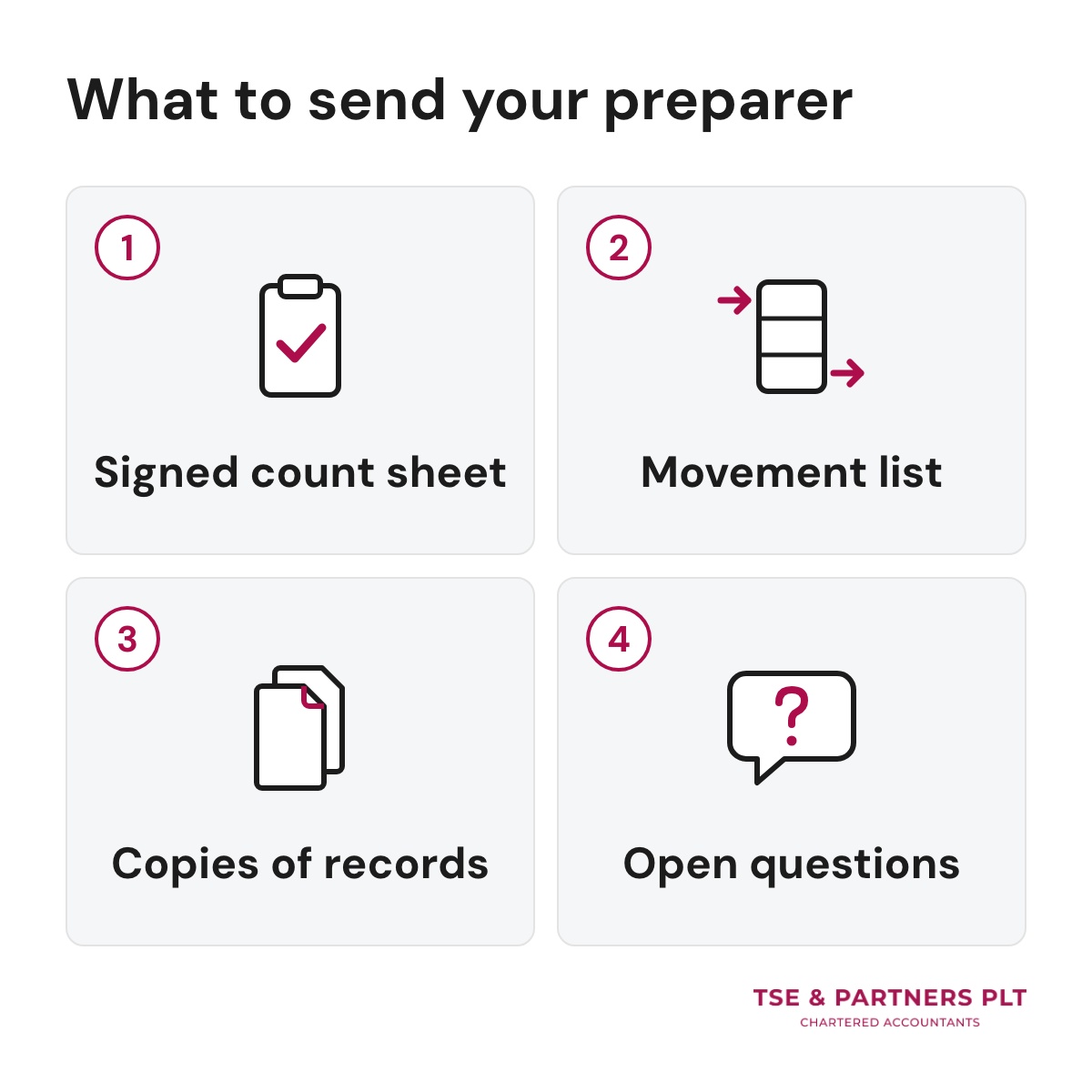
Send these 4 things together:
The signed count sheet.
A movement list for each item and location, giving each record's number, date, quantity, unit, direction (in or out) and status (confirmed or open).
Copies of the records on the movement list.
Your open questions, with who you asked and the answer, or "no answer yet".
When the draft statements come back, check the stock figure against your working and ask about any difference. Our guide on what to check before signing financial statements shows how directors record what they asked and were told for each draft. Filing goods received notes and delivery orders monthly, as part of a monthly bookkeeping checklist, makes the next late count quicker to work back.
TSE & Partners offers accounting and bookkeeping services in Kuala Lumpur through associates. Depending on the scope agreed with the associate, this can include Financial Statement Preparation from the records you supply. This support does not include audit, assurance, tax or SST work. If your count fell after year end, talk to TSE & Partners about the records you have.
Stock count after year end: common questions
Are sales after year end added or taken away?
Added back, if the goods left between the year-end cut-off and the count, because they were still in your store at year end. Use the date the goods left, not the invoice or payment date. Goods delivered before year end but invoiced later stay out.
What if a delivery order is unsigned or undated?
Leave it out of the figure and list it as an open question. Ask the person who handled it whether the goods left, when, and whether another record already covers them.
How long after year end can I count?
This guide sets no fixed limit. The longer the gap and the busier the trading, the harder the working is to support. If you cannot count at year end, agree the count date with your preparer first.
Is working back a stock count the same as an audit?
No. The working is your evidence for your preparer. It gives no assurance that the stock figure is right.
The information in this article is general guidance only. It does not constitute accounting, tax, financial or legal advice and may not fit your circumstances. Confirm the engagement scope and seek qualified advice before acting.