Key Takeaways
- Check the cover first: company, period, framework and audit status.
- Profit carries into retained earnings, and closing cash matches the balance sheet's cash.
- Last year's column shows what moved, and the notes show the detail.
- Turn each large movement into a question asking your accountant for an explanation or a document.
When your accountant sends the company's financial statements for the year, it is not always clear how to read them. Profit may be up while the bank balance is down, with no obvious page explaining why. This guide shows how to read financial statements in order, how they connect and how to turn what moved into clear questions for your accountant, whether in-house or from an outside financial statement preparation service.
How do you read a set of financial statements?
Start with the cover: which company, which period, which framework, and whether the statements are audited. Then read profit for the year, what the company owns and owes at the year-end date, and how cash moved. Compare each line with last year's column, open the notes for lines that moved, and write down your questions.
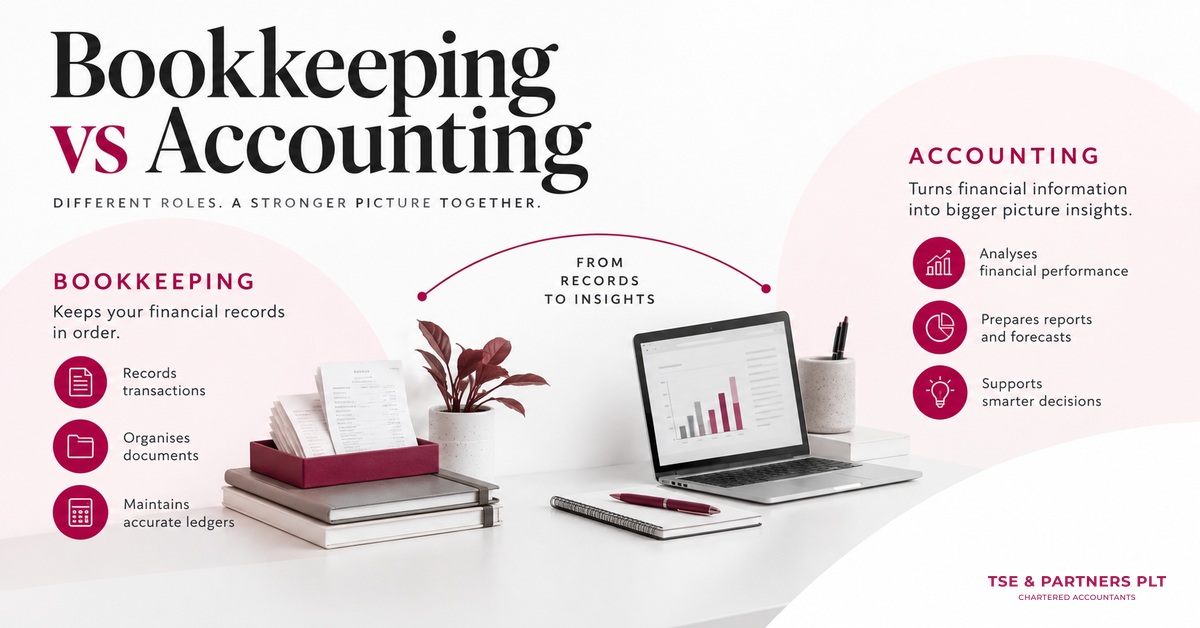
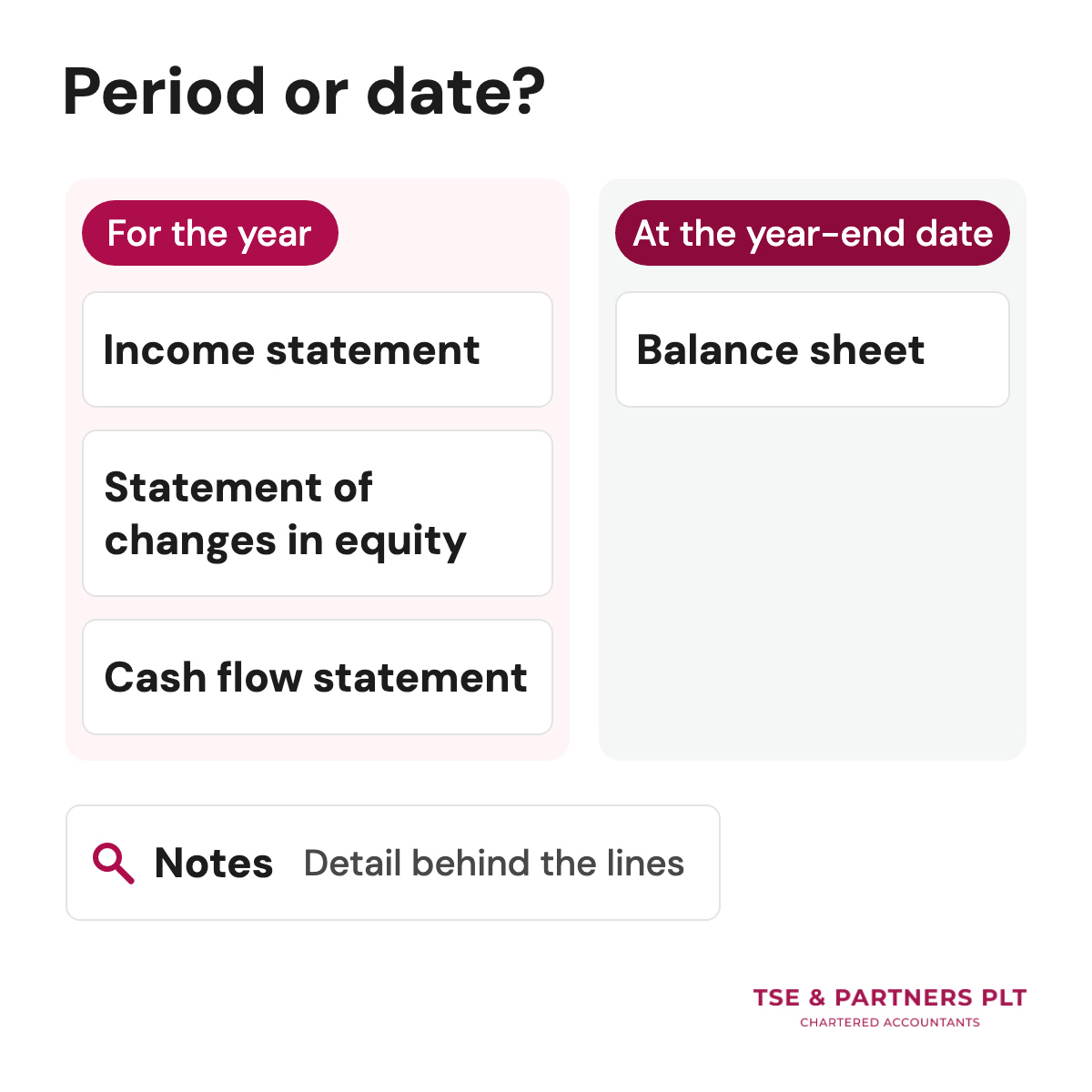
A full set has 4 statements, often under more than one name, plus the notes.
Income statement, or profit and loss account. Income and costs for the year, ending in profit.
Balance sheet, formally the statement of financial position. What the company owns (assets), owes (liabilities) and the owners' share (equity) on the last day of the year.
Cash flow statement. Cash in and out during the year, in three sections.
Statement of changes in equity. How the owners' share moved. Some small companies combine it with the income statement as a statement of income and retained earnings.
Notes. The accounting policies and the detail behind the main lines.
Monthly management accounts are different: internal reports in a format your business chooses, as management accounts vs financial statements explains.
Check which company, period and framework first
The cover and first pages tell you what you are holding.
Company. The name and registration number, and whether the statements cover the company alone or a group.
Period or date. "For the year ended 31 December 2026" covers a whole year. "As at 31 December 2026" means one day.
Currency. Usually RM, sometimes in thousands.
Framework. An early note names the accounting standards followed. A private entity, as the Malaysian Accounting Standards Board (MASB) defines it, uses either MPERS (Malaysian Private Entities Reporting Standard) or MFRS (Malaysian Financial Reporting Standards) in full.
Status. Whether an auditor's report is attached or the statements are marked unaudited. Unaudited financial statements explains what that means.
If the framework is MPERS, check the edition too. The new edition, MPERS 2025, applies to financial years beginning on or after 1 January 2027, and a company may adopt it earlier. What counts is when the year begins. A year from 1 January to 31 December 2026 stays on the earlier edition, MPERS 2016, unless the company adopted MPERS 2025 early. Some areas, such as revenue, differ between MPERS 2016 and MPERS 2025.
Why did cash fall when profit rose? A one-year example
When profit rises but the bank balance falls, the three main statements can show where to look. Consider an illustrative small trading company using MPERS 2016, with a financial year from 1 January to 31 December 2026. The figures are in RM.
Income statement for the year ended 31 December
| Line | 2026 | 2025 |
|---|---|---|
| Revenue | 1,200,000 | 1,050,000 |
| Cost of sales | (840,000) | (745,500) |
| Gross profit | 360,000 | 304,500 |
| Operating expenses (2026 includes depreciation of 20,000) | (250,000) | (230,000) |
| Finance costs | (6,000) | (7,000) |
| Profit before tax | 104,000 | 67,500 |
| Income tax expense | (25,000) | (16,200) |
| Profit for the year | 79,000 | 51,300 |
Profit for the year rose from RM51,300 to RM79,000.
Balance sheet at 31 December
| Line | 2026 | 2025 |
|---|---|---|
| Property, plant and equipment | 110,000 | 100,000 |
| Inventories | 150,000 | 110,000 |
| Trade receivables | 220,000 | 160,000 |
| Cash and bank | 46,000 | 102,000 |
| Total assets | 526,000 | 472,000 |
| Trade payables | 120,000 | 100,000 |
| Other payables and accruals | 30,000 | 28,000 |
| Tax payable | 8,000 | 5,000 |
| Bank loan due within 12 months | 20,000 | 20,000 |
| Bank loan due after 12 months | 50,000 | 70,000 |
| Total liabilities | 228,000 | 223,000 |
| Share capital | 100,000 | 100,000 |
| Retained earnings | 198,000 | 149,000 |
| Total equity | 298,000 | 249,000 |
| Total liabilities and equity | 526,000 | 472,000 |
Trade receivables, what customers owe, rose by RM60,000. Inventories, the stock, rose by RM40,000. Cash and bank fell from RM102,000 to RM46,000.
The cash flow statement below shows 2026 only, to keep it short. A full set also shows 2025.
Cash flow statement for the year ended 31 December 2026
| Line | 2026 |
|---|---|
| Profit before tax | 104,000 |
| Add depreciation | 20,000 |
| Add finance costs | 6,000 |
| Increase in inventories | (40,000) |
| Increase in trade receivables | (60,000) |
| Increase in trade payables | 20,000 |
| Increase in other payables | 2,000 |
| Cash generated from operations | 52,000 |
| Interest paid | (6,000) |
| Income tax paid | (22,000) |
| Net cash from operating activities | 24,000 |
| Purchase of equipment | (30,000) |
| Net cash used in investing activities | (30,000) |
| Bank loan repaid | (20,000) |
| Dividend paid | (30,000) |
| Net cash used in financing activities | (50,000) |
| Net decrease in cash | (56,000) |
| Cash at 1 January 2026 | 102,000 |
| Cash at 31 December 2026 | 46,000 |
Read the cash flow statement's 3 sections in turn.
Operating activities, the day-to-day trading, brought in RM24,000 against profit before tax of RM104,000. The biggest reasons for the gap: customers owed RM60,000 more and stock rose by RM40,000.
Investing activities used RM30,000 on equipment.
Financing activities, money from or back to lenders and shareholders, used RM50,000: RM20,000 of loan repaid and the RM30,000 dividend.
So the cash flow statement is the page that explains the fall. Trading brought in RM24,000, but RM30,000 went on equipment and RM50,000 on the loan repayment and dividend, so cash fell by RM56,000 even though profit rose.
In this example, interest paid sits in operating activities and the dividend in financing. MPERS is based on the international IFRS for SMEs Standard, which also allows interest paid in financing and dividends paid in operating, if the choice stays the same each year. MFRS has its own rules. Your own cash flow statement shows where your company puts them.
To trace the gap between profit and cash month by month from your management accounts, see profit vs cash flow.
How the 3 main statements connect
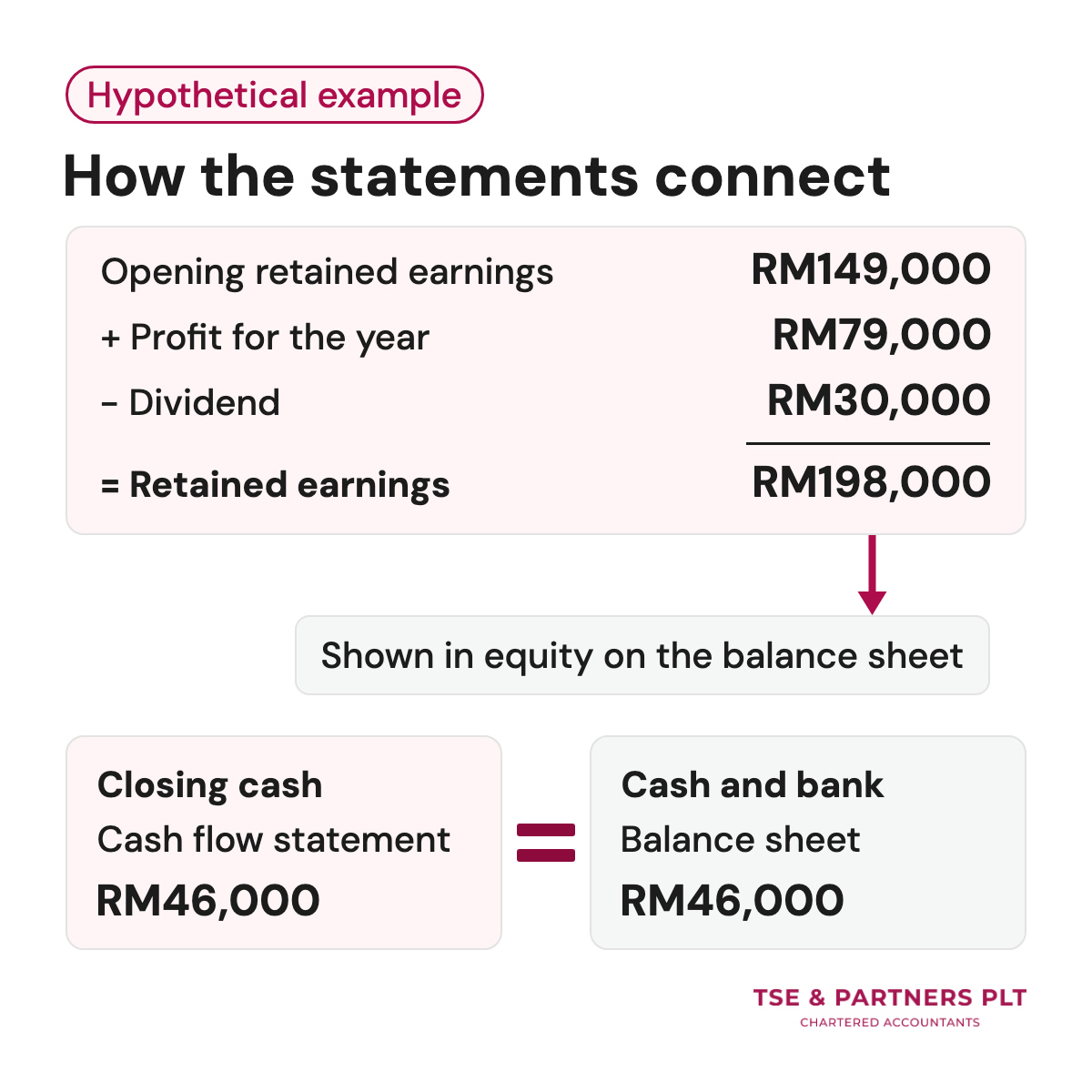
Profit carries into equity. Retained earnings are the profits the company has kept over the years rather than paid out as dividends. Opening retained earnings of RM149,000, plus profit of RM79,000, less a RM30,000 dividend, gives RM198,000. That is the retained earnings line in equity on the balance sheet. The statement of changes in equity shows this sum line by line.
The cash flow statement ends at the balance sheet's cash. It starts at RM102,000, falls by RM56,000 and ends at RM46,000, the cash and bank figure on the balance sheet.
Use last year's figures and the notes to find questions
Last year's column shows what moved. Revenue rose 14.3%, but trade receivables rose 37.5% and inventories 36.4%. When what customers owe grows faster than sales, that is worth a question.
Receivable days roughly show how many days of sales customers still owed at the year end: closing trade receivables divided by revenue, multiplied by 365. Here, about 67 days in 2026 against about 56 in 2025.
The notes hold the detail. The property, plant and equipment note shows RM100,000 at the start, RM30,000 of equipment added and RM20,000 of depreciation, the yearly charge that spreads an asset's cost over its useful life, leaving RM110,000. The borrowings note splits the RM70,000 loan into RM20,000 due within 12 months and RM50,000 after.
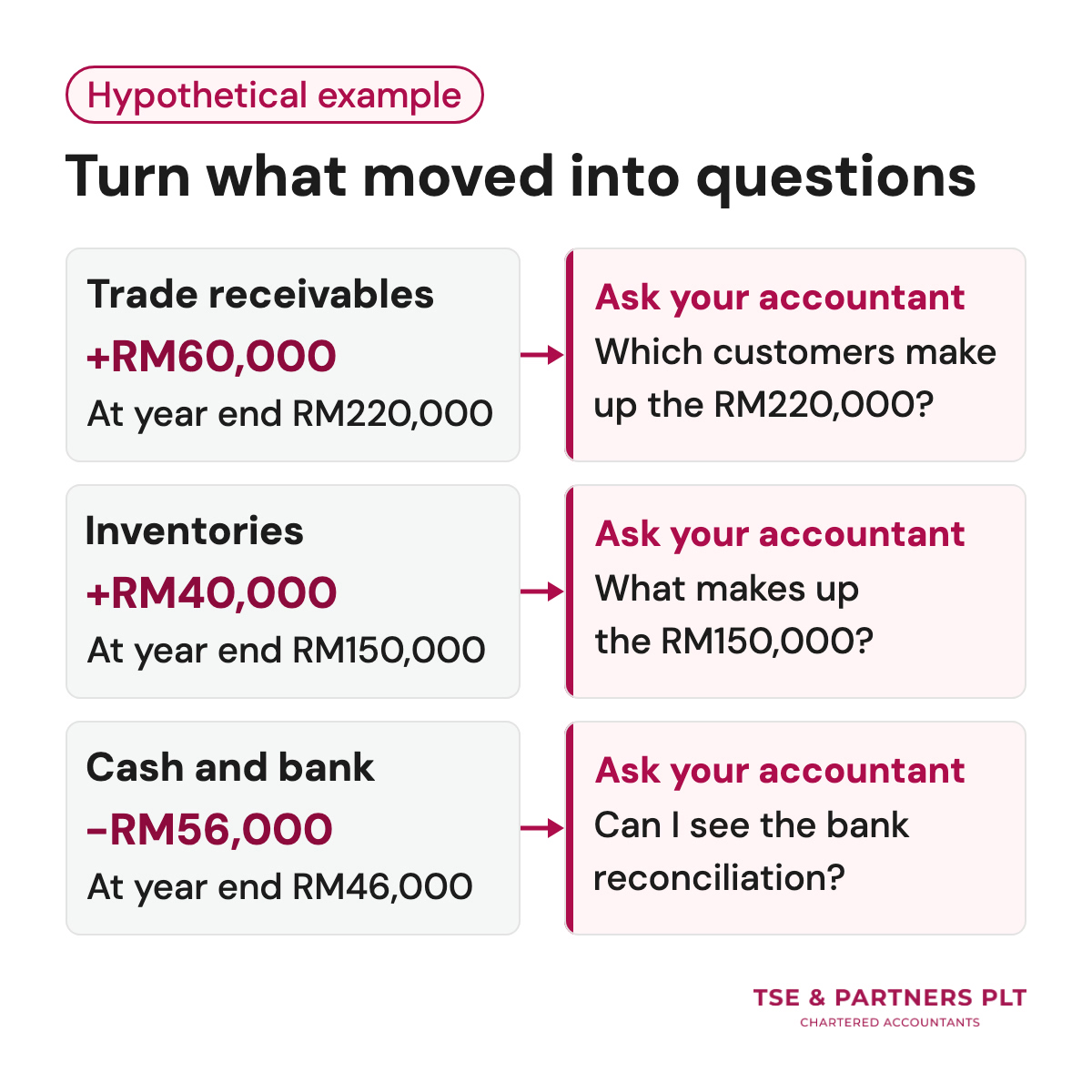
The table below lists each large movement, where you saw it and a question asking your accountant for an explanation or a document.
| What moved | Where you saw it | Question to ask your accountant |
|---|---|---|
| Trade receivables up RM60,000, about 67 receivable days | Balance sheet, trade receivables note | Which customers make up the RM220,000, and how much was overdue? Please send the aged receivables report at 31 December. |
| Inventories up RM40,000 | Balance sheet, inventories note | What makes up the RM150,000? If there was a stock count after year end, how was it worked back to 31 December? |
| Trade payables up RM20,000 | Balance sheet, trade payables note | How did you check for supplier invoices after year end that relate to 2026? |
| Bank loan down RM20,000 | Borrowings note | Can I see the bank's repayment schedule behind the RM20,000 due within 12 months? |
| Cash and bank down RM56,000 | Cash flow statement, balance sheet | Can I see the bank reconciliation that matches the RM46,000 to the bank statement? |
In the example, start with receivables and stock, which rose RM100,000 between them. In your own statements, start with the lines that moved most.
What the statements cannot tell you on their own
Financial statements record one year and the position on one date. On their own, they cannot tell you:
Why a figure moved. Receivables rose RM60,000, but the statements do not say whether a customer is paying slowly, disputing an invoice or was billed late.
How much cash you have today. The RM46,000 was the balance on 31 December. Later receipts and payments are not in the statements.
Whether estimates will hold. Some figures rest on estimates, such as how much customers will pay and what the stock is worth.
Answers come from your accountant and the company's own records. Before you approve the statements, what to check before signing financial statements shows how to test the larger figures against those records.
TSE & Partners supports Malaysian SMEs, especially in Kuala Lumpur, with Financial Statement Preparation delivered through associates. They prepare the statements from the records you supply, under the framework your company uses. This support does not include audit, assurance or tax work. To talk about your year-end statements, see our accounting and bookkeeping services in Kuala Lumpur or contact TSE & Partners.
Questions owners ask about reading financial statements
What does a small business financial statement look like?
Most sets open with a cover and contents page. Many include pages signed by the directors and, if audited, the auditor's report. The four statements and the notes follow, each showing this year and last year side by side.
Is a balance sheet the same as a statement of financial position?
Yes. Statement of financial position is the formal name, but companies may use another title, such as balance sheet, if it is not misleading. The income statement may likewise be titled profit and loss account or statement of profit or loss.
How are financial statements prepared for a small business?
Your accountant works from the company's complete records under MPERS or MFRS. These include the ledger, the running list of transactions the accounts are built from, plus bank statements and invoices. You supply facts and documents. Your accountant works out how each item is recorded, valued and shown, then sends a draft for the directors to review. The directors and management own the judgements behind the figures, and the directors decide whether to approve the statements.
Can ChatGPT analyse financial statements?
An AI tool can work out changes and ratios from the figures you give it. It cannot confirm those figures or explain the judgements behind them, so questions about what moved still go to your accountant.
Data Sources and References
Malaysian Accounting Standards Board (MASB), Approved Accounting Standards for Private Entities. Private entities apply either MPERS or MFRS in full. MPERS (2025) applies to annual periods beginning on or after 1 January 2027, with earlier application permitted.
Malaysian Institute of Certified Public Accountants (MICPA), The Malaysian Accountant, September to October 2025, PDF pages 32 to 33, reporting MASB's issue of MPERS (2025) and its effective date.
IFRS Foundation, IFRS for SMEs Accounting Standard, third edition (2025), issued text, paragraphs 3.3 (statement of compliance), 3.14 and 3.20 (comparatives), 3.17 to 3.19 (complete set), 3.22 (titles), 3.23 (identifying the statements), 6.4 (statement of income and retained earnings) and 7.14 to 7.17 (interest, dividends and income tax in the cash flow statement).
IFRS Foundation, IFRS for SMEs supporting material, Module 3 Financial Statement Presentation (2015 edition), paragraphs 3.3, 3.14, 3.17 to 3.23.
IFRS Foundation, IFRS for SMEs supporting material, Module 7 Statement of Cash Flows (2015 edition), paragraphs 7.14 to 7.17.
The information in this article is general guidance only. It does not constitute accounting, tax, financial or legal advice and may not fit your circumstances. Confirm the engagement scope and seek qualified advice before acting.